

Art is man's nature; nature is God's art.
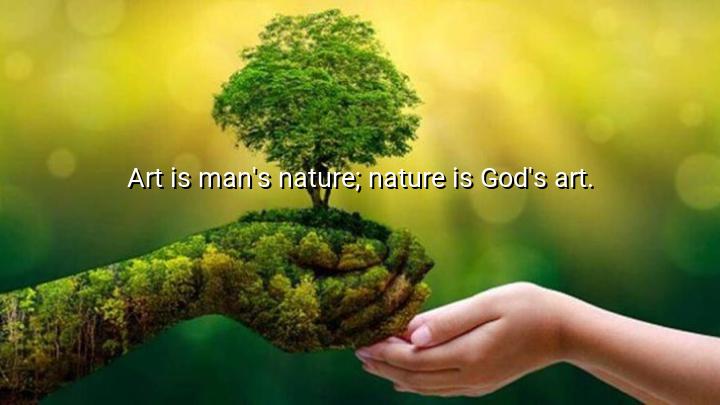




Philip James Bailey’s quote, “Art is man's nature; nature is God's art,” draws a poetic parallel between human creativity and divine creation. Bailey suggests that just as nature is the art crafted by God, art is the natural expression of the human spirit. In this sense, creating art is not something artificial or external to who we are—it's a core aspect of our human nature, a way we emulate the creative force that shaped the world around us.
As a 19th-century English poet, Bailey is best known for his epic poem Festus, where this quote originates. The work blends philosophy, theology, and romanticism, and this quote reflects his interest in reconciling spiritual belief with human potential. By placing God and man in parallel creative roles—one as the maker of nature, the other as the maker of art—Bailey honors both the divine and the human capacity to produce beauty, meaning, and truth.
The phrase “Art is man's nature” suggests that the impulse to create is as instinctive and essential as breathing. Just as trees grow and rivers flow, humans express, interpret, and imagine through art. Conversely, “Nature is God’s art” elevates the natural world as a masterpiece, full of design, complexity, and wonder—a source of inspiration that reflects divine intention.
Ultimately, Bailey’s quote is a celebration of the creative link between humanity and the divine. It invites us to see art not only as a human activity, but as a mirror of the greater creation that surrounds us. In making art, we participate in a sacred dialogue, echoing the beauty and order found in the natural world, and affirming our own place within a grand, ongoing act of creation.

ATNGUYEN SY ANH TRI
I appreciate the reverence in this quote, but I wonder how it applies in a modern, technological context. With so much of art now digital or AI-generated, does it still reflect human nature in the same way? And how does this compare to the unchanging beauty of natural landscapes or wildlife? Is Bailey’s contrast still relevant today, or does it need reinterpretation for the 21st century?
GNNguyen Gia Nhu
Honestly, this quote stirred a mix of emotions in me. I love the elegance of it, but I’m also skeptical. Can we really equate human nature to art? There’s a lot about humanity that isn’t beautiful—war, greed, destruction. If art is man’s nature, what does that say about us? Maybe this is more of an aspirational idea than a literal truth. Still, it’s a compelling notion.
TVTRANG VU
This is a deeply philosophical statement. It makes me question the distinction between what is ‘natural’ and what is ‘artificial.’ If human art is part of our nature, then isn’t it also, in a way, part of nature itself? The separation we often draw between nature and civilization might be more artificial than we realize. Bailey seems to challenge that boundary in a really profound way.
VHViet Hoang
I love the symmetry of this quote. It makes me think—does our drive to create stem from a desire to imitate the natural world, or to interpret it in a way that's uniquely human? I also wonder: if we destroy nature, are we not destroying God's art? There's a kind of responsibility embedded in this quote that I don't think we often acknowledge.
PD5.Pham Phuc Dat
I find this quote poetic, but I wonder about its implications. Is Bailey suggesting that humans are trying to replicate God's creation through art? If so, is it a form of homage, or a kind of rivalry? And can human-made art ever truly match the complexity and beauty of nature? I’d love to hear how different artists interpret their role in light of this perspective.