

Pictures deface walls more often than they decorate them.
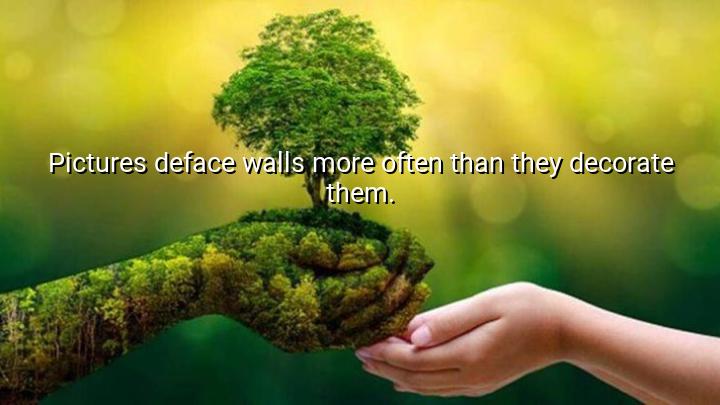




The quote "Pictures deface walls more often than they decorate them" by William Wordsworth offers a critical view of the role that art plays in shaping the environment. Wordsworth, a celebrated English poet, is suggesting that while pictures are often intended to beautify or enhance a space, they can also have a negative impact by disrupting the natural aesthetic or harmony of the setting. He seems to imply that the presence of too many images, particularly those that are incongruous or overly ornate, can clutter a space and detract from its true beauty, rather than enhancing it.
Wordsworth’s perspective aligns with his broader poetic philosophy, which often emphasized simplicity and nature. He believed that the beauty of the natural world should be appreciated in its pure, unaltered state. By suggesting that pictures deface rather than decorate, he is challenging the conventional view of art as something that always improves or adds value to the environment. For Wordsworth, the intrusion of art into a space could be seen as an artificial imposition, disturbing the natural aesthetic of the surrounding world.
This view also reflects Wordsworth’s broader critique of artificial or human-made constructs in contrast to the simple, untouched beauty of nature. Just as he often celebrated the natural world’s beauty in his poetry, Wordsworth here seems to argue that true beauty lies not in human-made decorations, but in the unadorned, organic world around us. Pictures, in his eyes, can sometimes be out of place in the natural landscape, reducing the harmony of the space they inhabit.
Ultimately, Wordsworth’s quote encourages us to think critically about the role of art in our surroundings. While pictures can enhance and beautify a space, they can also overwhelm or detract from the natural beauty around them. This is a reminder that not all forms of art are inherently positive in their impact, and sometimes less is more, especially when it comes to the decor of our environments.

QTQuynh Tran
Could Wordsworth have been reacting to the way art was being commodified in his time? Maybe he felt pictures were becoming fashion statements rather than heartfelt expressions. But isn’t that still happening today—art bought to match sofas instead of stir souls? It’s an uncomfortable thought, but maybe he’s calling us to think more deeply about what we place on our walls and what that says about our values.
CSMinh cuc suc
I wonder how this quote would land in today’s world of Instagram walls and digital aesthetics. Would Wordsworth see those too as defacement? His comment makes me question the difference between genuine decoration and visual noise. What criteria should we use to decide if something enhances or diminishes a space? Is there a universal standard, or is this entirely subjective and generational?
MT10CP-SN-19- Pham Dinh Minh Tram
Honestly, this quote seems a bit extreme. I get that Wordsworth valued nature and purity, but dismissing pictures so broadly feels limiting. Art can bring comfort, provoke thought, or celebrate culture. Isn’t that worthy of a place on our walls? What about murals or protest art that reclaim public space? I’d be curious to know what kind of images, if any, Wordsworth would actually approve of—or was he against all visual art indoors?
TTLe Van Tuan Tu
This quote really made me pause. It feels like a strong condemnation of visual art as it relates to interior spaces. Could Wordsworth have been responding to a trend of his time—maybe excessive ornamentation or poor artistic taste? Or was he advocating for simplicity, maybe even the sanctity of blank walls? Either way, it makes me reconsider what I choose to hang and why. Do our walls reflect who we are—or who we want to be?
TLtruong thi thuy linh
Do you think Wordsworth is criticizing modern tastes or just expressing a Romantic preference for nature over human-made imagery? As someone who enjoys decorating with personal photos and prints, I find his stance pretty harsh. Is it fair to say pictures deface walls if they bring joy or beauty to someone's space? Or is this just an elitist take on what qualifies as meaningful visual expression?