

Medicine is not only a science; it is also an art. It does not consist of compounding pills and plasters; it deals with the very processes of life, which must be understood before they may be guided.
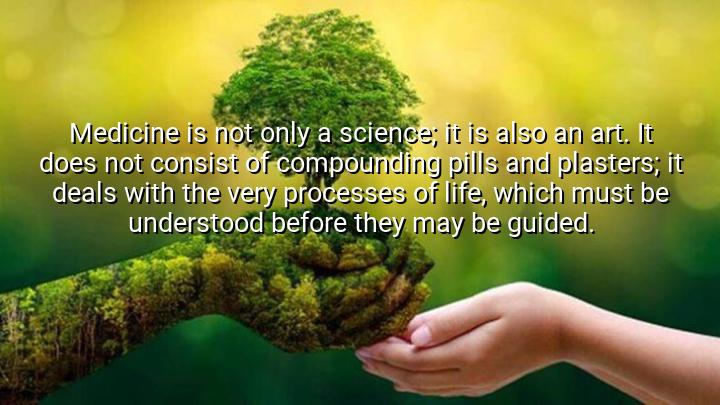




Paracelsus’ quote, "Medicine is not only a science; it is also an art. It does not consist of compounding pills and plasters; it deals with the very processes of life, which must be understood before they may be guided," highlights the dual nature of medicine as both a scientific and artistic endeavor. Paracelsus, a pioneering figure in early modern medicine, emphasizes that while medicine involves scientific knowledge—such as understanding the workings of the human body and disease—it also requires the art of understanding and guiding the processes of life.
By stating that medicine is not just about pills and plasters, Paracelsus is rejecting the reductionist view that healthcare is only about treating symptoms. Instead, he argues that true medicine involves a deeper understanding of life itself, including its complex, interconnected processes. To treat illness effectively, a doctor must first understand the full scope of human life, including the physical, emotional, and spiritual dimensions, before attempting to guide or heal it.
The idea that medicine is also an art reflects the need for intuition, compassion, and judgment in medical practice. Doctors must use their knowledge and skills to not only diagnose and treat but also to engage with patients on a deeper level. Paracelsus suggests that the human experience cannot be fully understood through science alone and that the art of healing requires a connection to the person as a whole.
Ultimately, this quote underscores the importance of integrating both science and art in medicine. Paracelsus’ philosophy advocates for a holistic approach to healthcare, where the practice of medicine is seen as an evolving balance between knowledge and humanity, and where the art of healing is as crucial as the science behind it. This dual perspective has continued to shape modern medical practice, emphasizing the significance of both scientific precision and compassionate care.

DHDuong Hoang
This quote seems to argue for a more integrative model of care. It makes me think about the divide between Western medicine and practices like Ayurveda or Traditional Chinese Medicine, which inherently combine art, philosophy, and science. Could these models provide modern medicine with a more complete understanding of life’s processes? Should more medical systems be open to merging ancient wisdom with current scientific practices?
TKHoang Trung Kien
I appreciate the depth of this quote—it reminds me that healing isn’t just about fixing what’s broken, but understanding how the body and mind work as a whole. But here’s my concern: in today’s fast-paced, insurance-driven medical world, is there even room for this artful approach? How can physicians balance the pressure of limited time with the need to truly understand their patients’ lives and not just their symptoms?
TNTraan Ne
Paracelsus’s quote makes me think of how medicine is often seen as cold and clinical. Yet, the idea that it's an art forces us to recognize the importance of creativity and intuition in diagnosis and treatment. Should we be integrating more humanities—like philosophy or narrative medicine—into our medical curricula? Could this help create more compassionate and insightful healthcare professionals?
THThao Ha
This quote challenges the reductionist view of medicine. It suggests a more holistic approach, where understanding life itself is a prerequisite to treatment. But what does it really mean to ‘understand life’? Is it biology, psychology, spirituality—or all of them? I’d love to hear more about how different cultures or traditions interpret this fusion of science and art in the healing process. Are we too Western in our current frameworks?
PTLe Phuoc Tai
I find this perspective incredibly insightful. It reminds me that doctors aren't just technicians—they’re interpreters of life. But it also makes me wonder: how do medical schools balance teaching hard science with cultivating the more nuanced skills like listening and empathy? Are we adequately preparing future physicians to be both scientists and artists of healing? Or are we undervaluing the role of emotional intelligence in patient care?