

Once a disease has entered the body, all parts which are healthy must fight it: not one alone, but all. Because a disease might mean their common death. Nature knows this; and Nature attacks the disease with whatever help she can muster.
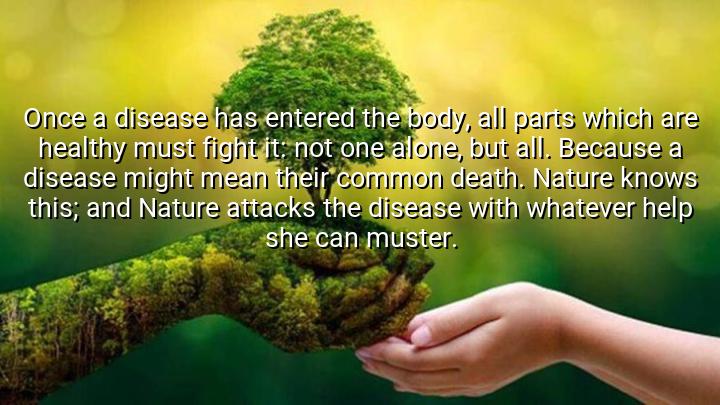




The quote, "Once a disease has entered the body, all parts which are healthy must fight it: not one alone, but all. Because a disease might mean their common death. Nature knows this; and Nature attacks the disease with whatever help she can muster," is from Paracelsus, a Swiss physician and philosopher known for his contributions to the development of modern medicine and chemistry. In this statement, Paracelsus uses the metaphor of the body to explain the way natural systems work together to combat illness and maintain overall health.
Paracelsus emphasizes the importance of unity within the body’s response to disease. When a harmful agent enters the body, every healthy part of the body, from the immune system to organs, must work together to eliminate it. He stresses that no single part can handle the threat on its own. This idea parallels his holistic approach to health, where he believed that the body should be viewed as an interconnected system, not as separate components functioning independently.
The mention of death refers to the potential seriousness of the illness, suggesting that if left untreated or if only one part of the body attempts to fight the disease, the entire organism is at risk. Paracelsus' insight reflects his understanding that health is a collaborative effort among all parts of the body. When one part is threatened, the whole body must act in unison to restore balance and fight the disease.
Ultimately, Paracelsus attributes the wisdom of the body’s response to Nature itself, which knows how to mobilize the body's defenses. By invoking Nature, he suggests that the body’s ability to fight disease is an inherent, natural process, one that relies on collective action and cooperation within the body. This perspective underscores Paracelsus' belief in the natural, self-healing capacities of the body and the interconnectedness of all its parts.

AVThu Anh Vo
Paracelsus’ metaphor suggests a collective struggle for survival within the body, which could also reflect broader ideas about cooperation. How might this philosophy be applied beyond biology—to social groups, ecosystems, or even global health? Does recognizing interconnectedness inspire more collaborative solutions to shared problems, whether medical or societal?
GDGold D.dragon
This statement makes me reflect on the resilience of living systems. How does the body ‘know’ to rally all healthy parts against a threat? Is this an automatic biological process or something more mysterious? I’m also curious how this principle could inform preventive medicine, emphasizing overall health to empower the body’s united response.
LGluong gia
Reading this, I wonder about the balance between natural defenses and medical intervention. While Nature fights with whatever help she can muster, when should humans step in, and how can we complement the body’s efforts? Are there risks in over-relying on natural processes or, conversely, in aggressive treatments that might disrupt this harmony?
HNHuy Nguyen
I’m fascinated by the idea that all healthy parts of the body must unite against disease to ensure survival. Could this concept extend to mental or emotional health, where different aspects of the self must collaborate to overcome trauma or stress? Also, how might this perspective influence patient care, encouraging a more integrated approach rather than treating symptoms in isolation?
MTle nguyen minh thuy
This quote sparks curiosity about the body’s innate intelligence in combating illness. How does ‘Nature’ coordinate such a complex defense system? Are there ways humans can support this natural response through nutrition, rest, or mindset? It also raises philosophical questions about the relationship between individual parts and the whole—can this idea be applied metaphorically to communities or societies facing collective challenges?