

Dreams are not without meaning wherever thay may come from-from fantasy, from the elements, or from other inspiration.
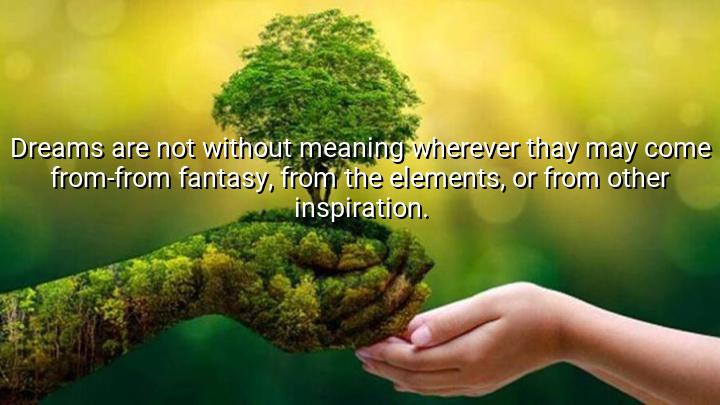




Paracelsus’ quote emphasizes the importance and meaning of dreams, suggesting that they are not random or trivial, regardless of their origin. Whether dreams arise from fantasy, the elements of nature, or some other form of inspiration, Paracelsus believes they carry significance. This perspective suggests that dreams serve as a window into the unconscious mind, offering insights that are not immediately apparent in the waking world. By acknowledging different sources of inspiration, he elevates the mystery of dreams, encouraging us to consider them as a valuable aspect of the human experience.
The mention of dreams coming from fantasy, the elements, or other inspiration highlights the mystical and multifaceted nature of dreaming. Paracelsus, a Swiss physician and alchemist, had a deep interest in the occult, alchemy, and the integration of spiritual and scientific knowledge. His philosophy often blurred the line between the rational and the spiritual, and this quote reflects his belief that dreams could be both an internal product of the mind and an external communication from the universe or the natural world. Dreams, for him, were not just idle thoughts but manifestations of higher truths.
The origin of the quote lies in Paracelsus’ work as a philosopher, physician, and alchemist during the Renaissance. He is known for his unconventional approaches to medicine and his belief in the interconnectedness of mind, body, and spirit. His studies often included the exploration of astrology, alchemy, and mysticism, and he viewed dreams as potentially revealing deep, hidden knowledge. Paracelsus' views on dreams were shaped by his broader interest in human consciousness and the mysteries of the natural world.
Ultimately, Paracelsus' quote encourages us to explore the meaning and purpose of our dreams, whether they are born from the fantasy world of our minds, the mystical elements of nature, or other sources of inspiration. It suggests that dreams are not to be dismissed as mere fantasies but are significant and can provide us with valuable insights into ourselves and the world around us.

AAdministratorAdministrator
Welcome, honored guests. Please leave a comment, we will respond soon