

Like art, revolutions come from combining what exists into what has never existed before.
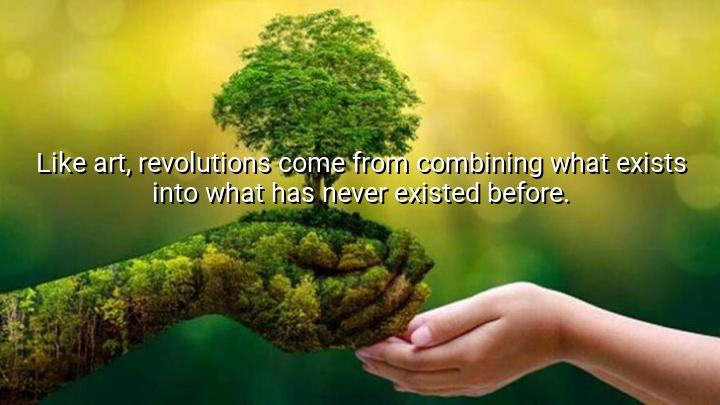




Gloria Steinem’s quote, "Like art, revolutions come from combining what exists into what has never existed before," draws a parallel between the creative process of art and the transformative nature of revolutions. Steinem suggests that both art and revolution are driven by the ability to take existing elements, whether they be ideas, materials, or structures, and combine them in innovative ways to create something entirely new. In this sense, both are forms of creativity that challenge the status quo and seek to bring about meaningful change.
The phrase "combining what exists into what has never existed before" speaks to the act of innovation. In art, artists take inspiration from the world around them—ideas, emotions, and experiences—and combine them into new forms, pushing the boundaries of expression. Similarly, in a revolution, individuals or groups challenge existing systems and norms by creating new models of society, governance, or relationships that have never been seen before. This process of synthesis is what drives both artistic and societal evolution.
Steinem’s comparison also highlights the disruptive nature of both art and revolutions. Just as art has the power to shift perspectives and provoke new ways of thinking, revolutions seek to disrupt established orders and create a new vision of what is possible. Both are catalysts for change—art shifts culture and consciousness, while revolutions aim to reshape the structures and systems that govern society.
Ultimately, Steinem’s quote emphasizes the creative power of both art and revolution to bring about significant change by reimagining the world. It underscores the idea that true progress in either realm requires boldness, innovation, and the willingness to merge existing ideas into something new and transformative. This concept aligns with Steinem's own work in feminism and social justice, where she has advocated for breaking down traditional barriers to create more inclusive and equitable structures.

NLNam Le
I think what fascinates me most about this quote is the suggestion that innovation is about synthesis, not originality in isolation. It frames revolution not as an explosion but as an evolution. Do you think this outlook can help de-escalate conflict in social movements—by emphasizing creativity over confrontation? Or does it risk diluting the urgency behind real revolutionary action? I'm torn, but the quote definitely opens up a rich philosophical discussion.
NNNhu Ngo
It’s interesting how this quote implies that both art and revolution rely on vision—the ability to see potential in what others overlook. I’d love to explore how this concept applies to grassroots activism or community organizing. What existing resources or traditions could be reimagined to create systemic change? This kind of thinking feels deeply tied to hope and resilience, and it challenges the idea that revolution is only for radicals or rebels.
MQnguyen minh quan
This strikes me as a really empowering idea, especially for those who feel like change is impossible. If revolutions are just new combinations of old things, then anyone can be a part of that change. It makes me wonder: in today’s world of constant innovation, are we seeing more revolutions than we realize? Maybe progress isn’t always about inventing something completely new, but remixing what’s already here into a better form.
QTDang Quynh Trang
I appreciate how Steinem draws a parallel between art and revolution—it’s poetic and insightful. But I also wonder: does this view risk romanticizing revolutions? Many revolutions are messy, painful, and violent. Can we really say they come from the same kind of creative spark as art? Or is the quote pointing to the mindset of innovation rather than the methods? It’s a compelling metaphor, but it definitely raises some tough questions.
CDNguyen Cong Danh
This quote really got me thinking—can creativity be the most powerful force behind social change? It suggests that revolutions aren't necessarily about destruction, but about recombination—finding new meaning in what's already around us. That feels incredibly hopeful. Do we underestimate the role of imagination and aesthetics in political movements? I’d love to hear examples of historical or artistic revolutions that followed this path of transformation through reassembly.