

Monotheism makes me grouchy. I don't trust any religion that makes God look like one of the ruling class. I guess I'm a pagan or an animist.
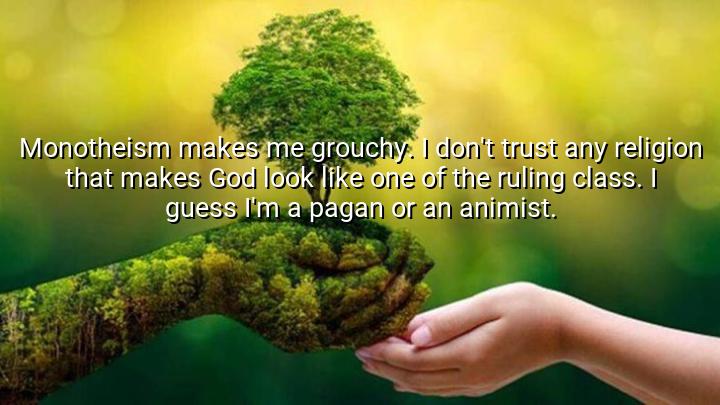




In this quote, Gloria Steinem, a prominent feminist and social activist, expresses her discomfort with monotheism, particularly with the concept of God being portrayed as a figure from the ruling class. Steinem suggests that she doesn't trust any religion that elevates God to the position of an absolute, singular authority figure, ruling over people like a monarch or dictator. This reflects her skepticism about religious systems that often mirror hierarchical and oppressive societal structures. By saying she is more aligned with paganism or animism, Steinem indicates a preference for belief systems that view the divine as more pluralistic, decentralized, or connected to the natural world, rather than concentrated in a single authoritative being.
Steinem’s critique is grounded in her belief that monotheism, in many cases, reflects patriarchal power structures, where the image of God as a supreme ruler often reinforces societal inequality and oppression. This aligns with her broader critiques of systems that perpetuate the subjugation of women and marginalized groups. By rejecting the idea of a God who embodies the characteristics of an authoritarian ruler, she is also rejecting a religion that she feels may have been used to justify oppressive power dynamics.
The origin of this quote is tied to Steinem’s broader philosophical and feminist views, which often challenge traditional power structures and promote equality and freedom for all individuals. Throughout her career, Steinem has advocated for social justice, gender equality, and the dismantling of patriarchal systems—views that often intersect with her reflections on religion. Her critique of monotheism reflects a broader questioning of authority and hierarchical systems, which she believes can be found not only in religion but also in many aspects of society.
Ultimately, Steinem’s quote is a statement about her discomfort with monotheistic religions that project patriarchal or authoritarian values onto the concept of the divine. By identifying with paganism or animism, she embraces a view of the divine that is less about control and more about interconnectedness, nature, and a pluralistic understanding of spirituality. In doing so, she aligns herself with belief systems that encourage a more inclusive and democratic approach to understanding the sacred.

AAdministratorAdministrator
Welcome, honored guests. Please leave a comment, we will respond soon