

Life is the art of drawing without an eraser.
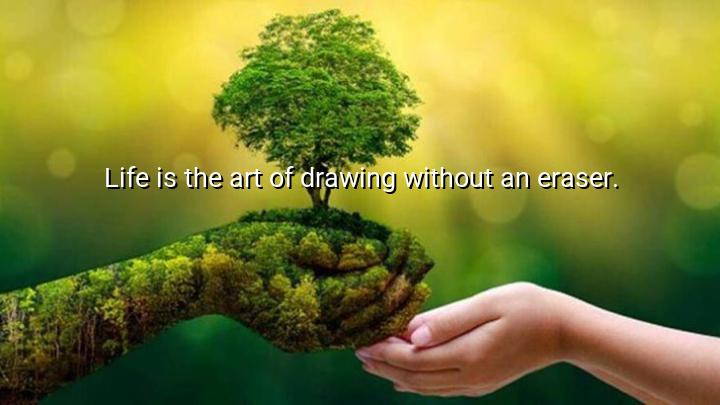




In this quote, John W. Gardner compares life to the art of drawing without an eraser, suggesting that life, unlike a drawing on paper, offers no opportunity for corrections or do-overs. Just as an artist must carefully consider every line when drawing, we must make choices and decisions in life without the luxury of erasing mistakes. The quote highlights the irreversibility of life’s actions, urging us to approach life with intention and mindfulness, understanding that every decision contributes to the permanent path we create for ourselves.
The origin of the quote can be understood in the context of Gardner’s role as an educator, author, and public servant. Gardner was known for his thoughts on leadership, personal development, and the human experience. As someone who worked in both education and government, he often reflected on the importance of responsibility, accountability, and the impact of decisions. His view here aligns with the idea that, in life, we cannot rely on external tools or excuses to undo our choices but must take full ownership of the direction our lives take.
Gardner’s use of drawing and the absence of an eraser serves as a metaphor for living in the present and making thoughtful decisions. Unlike a drawing that can be easily corrected or changed, life’s moments are unrepeatable and come with lasting consequences. The absence of an eraser suggests that we must carefully consider our actions and choices, knowing that, once made, they are part of the ongoing story of our lives.
Ultimately, this quote challenges us to live with a sense of purpose and awareness. Without the chance to erase or undo our actions, we must approach life with courage, taking responsibility for our decisions while understanding that they shape the narrative of our existence. The message encourages us to embrace life’s complexities, knowing that each line we draw is part of the larger picture we create.

HTLac Huu Tan
This quote reminds me of the beauty of imperfection. If there's no eraser, then maybe it's not about avoiding mistakes but finding a way to make them part of the art. Like turning a smudge into a shadow. That actually gives me hope. But still, I sometimes wonder—how do we know when we’ve done enough with what we’ve been given? What if the drawing feels incomplete?
HATruong Huu An
It’s interesting that Gardner uses 'drawing' instead of 'writing.' Drawing feels more emotional, maybe even more personal. No eraser makes every stroke count, which is a little intimidating. But is that pressure necessary for a meaningful life? Or do you think this mindset can create anxiety over making mistakes, rather than embracing them? I’d love to hear other perspectives on whether life should be lived this deliberately.
UGUser Google
I love the creative imagery in this. It makes me think about how life demands courage—drawing freely without knowing if we’ll mess it up. Maybe that’s the beauty of it. But I also wonder, what about those who are afraid to draw at all? Is the fear of a permanent mistake holding people back from actually living? How do we balance being cautious with being bold?
MMMagatsuchi Mai
I'm struck by the realism of this quote. It’s a little sobering, honestly. If life has no eraser, does that mean regret is inevitable? I sometimes wish I could undo certain things, but maybe that’s part of what makes life meaningful—the permanence. Still, I’m curious: how do we forgive ourselves for the marks we wish we hadn’t made? Is reflection our only tool to move forward?
NRNhac Remix
This quote hit me hard. It's such a simple metaphor, but it carries so much truth. We really don’t get a do-over in life, do we? Every decision, every mistake—it stays with us in some way. I wonder, though, how much we can actually 'redraw' around the lines we've already made. Do you think people can truly reinvent themselves, or are we always defined by our past strokes?