

Much education today is monumentally ineffective. All too often we are giving young people cut flowers when we should be teaching them to grow their own plants.
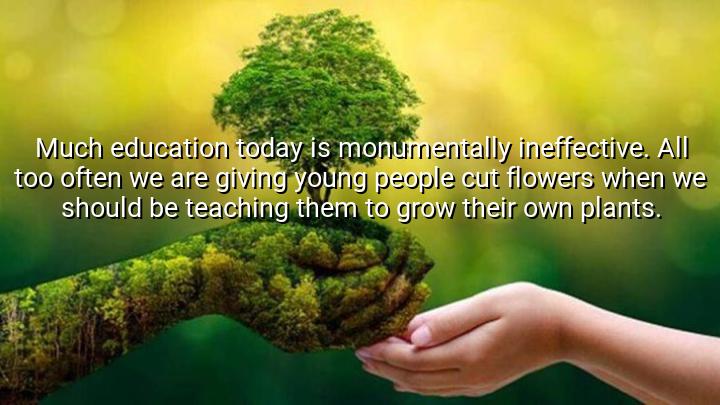




In the quote "Much education today is monumentally ineffective. All too often we are giving young people cut flowers when we should be teaching them to grow their own plants," John W. Gardner critiques modern education for focusing too much on delivering ready-made knowledge instead of fostering the skills and abilities necessary for independent thought and growth. He uses the metaphor of cut flowers to represent knowledge that is handed to students in a fixed, static form, without encouraging them to engage in the process of learning, discovery, and problem-solving. Gardner suggests that education should not just be about transferring information but about teaching students how to cultivate their own understanding and skills over time.
Gardner’s metaphor of growing plants emphasizes the idea that education should be about nurturing the ability to think critically, ask questions, and solve problems, just as one would cultivate a plant from a seed. He implies that by focusing on independent learning and developing self-sufficiency, students can gain the tools they need to continuously grow and adapt throughout their lives. This approach empowers them to become lifelong learners, capable of navigating new challenges without relying on pre-packaged answers.
The quote also reflects Gardner’s belief in the importance of active learning, where students are encouraged to be engaged and take ownership of their educational journey. Instead of passively receiving information, students should be taught how to seek out knowledge, experiment, and learn from their own experiences. This dynamic process of learning promotes deeper understanding and helps students develop the skills they need to thrive in a rapidly changing world.
Ultimately, Gardner’s quote calls for a shift in educational philosophy, one that values critical thinking and self-reliance over rote memorization or passive consumption of information. By teaching young people how to grow their own plants, education can become a tool for cultivating creativity, resilience, and adaptability—qualities that are far more valuable than simply being handed solutions.

AAdministratorAdministrator
Welcome, honored guests. Please leave a comment, we will respond soon