

When one may pay out over two million dollars to presidential and Congressional campaigns, the U.S. government is virtually up for sale.
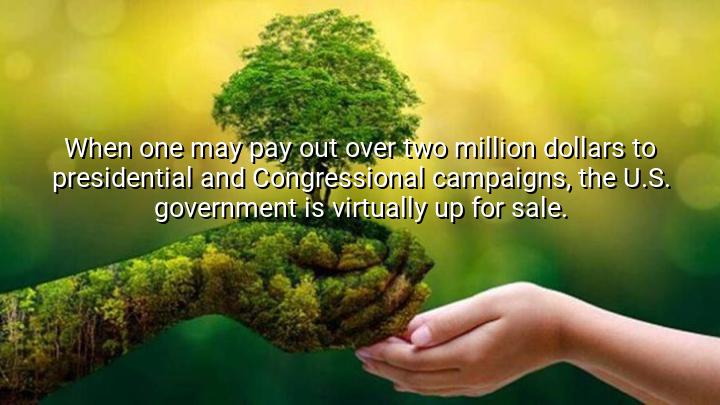




John W. Gardner’s quote highlights the immense influence of money in political campaigns and its potential impact on the integrity of democratic processes. When Gardner points out that individuals or organizations can contribute over two million dollars to presidential and Congressional campaigns, he is pointing to the outsized role that financial contributions play in shaping political outcomes. The implication is that when such large sums are involved, the government can be swayed or influenced by those with the financial resources to back specific candidates or policies.
Gardner’s statement, "the U.S. government is virtually up for sale," is a critique of the corruption and inequality that arises when political influence is tied to wealth. His words suggest that the political system, when driven by substantial monetary donations, becomes vulnerable to special interests that can buy access, policy influence, or even legislative outcomes. In this sense, the government may no longer function as a truly democratic institution, but rather as a system where the rich and powerful hold disproportionate sway over decisions that affect the entire population.
The quote likely stems from Gardner’s concerns during a time when the influence of campaign finance was growing, especially with the rise of Super PACs and large political donations. These entities can contribute vast sums to campaigns without the same level of scrutiny or limitations that traditional political funding sources faced. Gardner’s warning about the sale of government reflects the broader concern over the corruption of the political system, where elections are won not necessarily by the candidates with the best policies, but by those with the most financial backing.
Ultimately, Gardner’s quote is a powerful commentary on the growing issue of money in politics, highlighting how financial contributions can distort the democratic process. It serves as a call to examine and address the disproportionate influence that wealthy individuals and organizations can have over government decisions, urging a reevaluation of the relationship between campaign financing and political power.

AAdministratorAdministrator
Welcome, honored guests. Please leave a comment, we will respond soon