

It doesn't pay to say too much when you are mad enough to choke. For the word that stings the deepest is the word that is never spoke, Let the other fellow wrangle till the storm has blown away, then he'll do a heap of thinking about the things you didn't say.
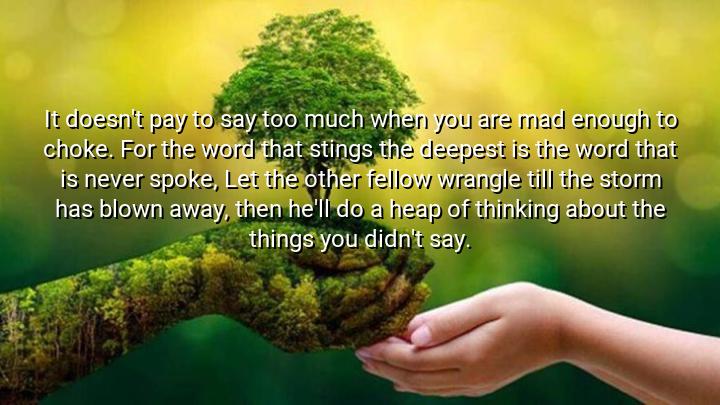




In this quote, Jules Renard emphasizes the importance of restraint and the value of silence when feeling intensely angry. He suggests that when we are so angry that we feel we could “choke,” it’s better to remain silent rather than speak impulsively. The words we speak in the heat of the moment are often the most harmful, and the deepest hurt is caused by the things we say out of anger. Renard’s point is that it’s wiser to hold back and allow the emotion to settle before responding.
Renard’s advice touches on the idea of emotional intelligence—the ability to recognize when it’s best to pause and allow emotions to cool before engaging. When we speak while we are angry, we risk saying things that are not only unhelpful but also damaging to relationships. The phrase "the word that stings the deepest is the word that is never spoke" suggests that sometimes, silence is more powerful than any argument or retort, especially when it gives both parties the chance to reflect on the situation with a clearer mind.
The origin of this quote lies in Renard’s broader understanding of human behavior and relationships. As a French writer, Renard often explored themes of introspection, personal conflict, and the complexities of communication. His focus on restraint in moments of intense emotion reflects a deeper belief in the power of silence to preserve peace and to avoid regretful actions.
Ultimately, Renard’s quote teaches the value of patience and self-control during times of anger. It suggests that, by refraining from speaking in the heat of the moment, we allow ourselves the opportunity to think more clearly and avoid saying things that we might regret. By choosing silence, we also create the space for others to reflect on their actions and words, often leading to more productive and thoughtful resolutions once the emotional storm has passed.

TNTuynh nguyen
This quote makes me reflect on personal experiences where saying less in anger saved relationships. But I wonder if there’s a risk of under-communicating and causing misunderstandings. How do people balance the need to protect themselves from saying hurtful things with the need for honest dialogue? It would be interesting to explore techniques for mindful communication after emotional conflicts.
GHTran Gia Han
I appreciate the poetic quality of this statement—sometimes the most powerful messages are those left unsaid. But how do we decide which words to keep silent and which must be spoken? Could this quote be encouraging a form of quiet strength rather than passive silence? I’d like to hear perspectives on how silence can be both healing and hurtful.
TVTrieu Thi Van
This quote highlights patience and emotional intelligence in conflict. Waiting for the ‘storm to blow away’ can allow for clearer thinking on both sides. But what happens if the other person never reflects or changes? Does silence risk letting issues fester or being misinterpreted? It raises important questions about timing and intent in difficult conversations.
TOThao offline
The notion that unspoken words can sting the deepest is intriguing. It suggests that withholding thoughts can be a form of subtle power. But could this also lead to passive-aggressiveness or unresolved tension? How can we ensure that strategic silence doesn’t become avoidance? I’m curious about how people can communicate effectively without needing to say everything immediately.
PTPhuong Tran
I find this idea very relatable—there’s a wisdom in letting emotions settle before responding. But does staying silent always lead to reflection in the other person, or can it sometimes create confusion and frustration? How do different personalities interpret silence after conflict? I’d love to explore how this approach varies across cultures and communication styles.