

Laziness is nothing more than the habit of resting before you get tired.
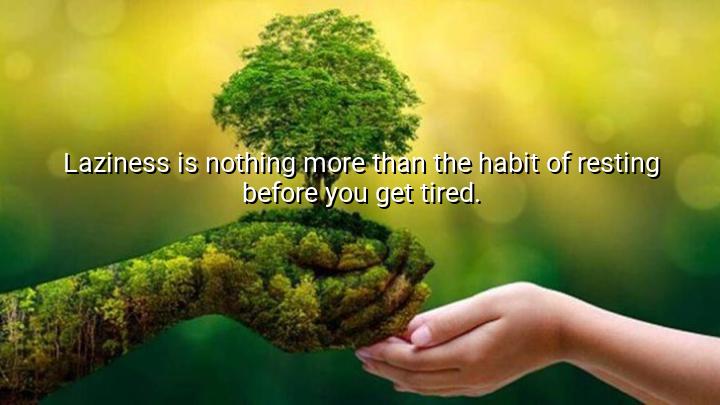




The quote by Jules Renard, "Laziness is nothing more than the habit of resting before you get tired," presents a clever and insightful perspective on laziness. Renard is suggesting that laziness is not necessarily a natural state, but rather a pattern or habit formed by avoiding work or effort before it is truly needed. Essentially, laziness is about resting prematurely, when there is still energy to be spent. It’s the habit of taking a break or choosing inactivity before the body or mind actually requires rest, which ultimately leads to procrastination and unproductive behavior.
Jules Renard, a French writer known for his sharp observations of human nature, often used wit and irony to explore everyday life and personal behaviors. This quote fits within his broader literary style, which frequently commented on the contradictions and quirks of human actions. Renard’s reflection on laziness suggests that it is a mindset or pattern, rather than an inherent trait. It highlights how people can fall into a cycle of avoiding effort and delay tasks unnecessarily, sometimes out of habit or a false sense of needing rest.
The phrase "resting before you get tired" emphasizes how laziness involves avoiding work or action before the body or mind has even reached a point of exhaustion. It suggests that laziness is a form of preemptive avoidance, where one chooses to be inactive without legitimate reasons. This can often lead to feelings of guilt or unfulfillment, as tasks are left undone until later, causing stress or inefficiency when they eventually need to be completed.
Ultimately, Renard’s quote is a reminder that laziness is a habitual behavior that can be managed or avoided by recognizing the tendency to rest or procrastinate prematurely. It encourages individuals to act and engage in tasks before the desire for rest overtakes them, promoting a more proactive and productive approach to life. By acknowledging laziness as a habit, Renard suggests that it is something that can be changed with awareness and effort.

AAdministratorAdministrator
Welcome, honored guests. Please leave a comment, we will respond soon