

Intelligence is the ability to solve problems, whereas consciousness is the ability to feel things such as pain, joy, love, and anger. Throughout history, intelligence always went hand in hand with consciousness.
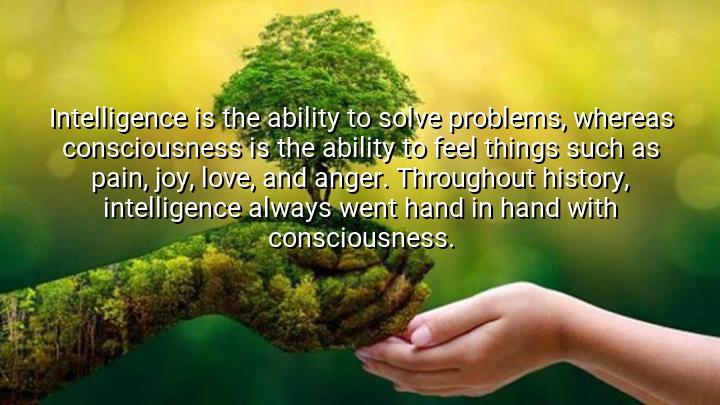




Yuval Noah Harari’s quote distinguishes between intelligence and consciousness, two fundamental aspects of human experience. He defines intelligence as the ability to solve problems, which involves using cognitive skills to navigate challenges, make decisions, and adapt to circumstances. In contrast, consciousness refers to the ability to experience and feel a range of emotions, such as pain, joy, love, and anger. While intelligence is often associated with logical reasoning and problem-solving, consciousness is more concerned with the subjective, emotional, and sensory experiences that define human life.
Harari’s assertion that intelligence and consciousness have always gone hand in hand throughout history reflects the deep interconnection between these two traits in human evolution. Historically, human beings have used their intelligence to address challenges, while their consciousness has allowed them to connect with their emotions and the experiences that make life meaningful. This interconnectedness has been crucial in shaping the way humans navigate their environments, relationships, and personal growth.
By emphasizing that intelligence and consciousness are not separate but complementary, Harari highlights the complexity of human nature. Consciousness allows individuals to reflect on their emotions and experiences, while intelligence provides the tools to understand and act upon these feelings. The balance between these two aspects of the human mind is what enables people to both feel deeply and solve the problems that arise from those emotions, creating a rich and dynamic experience of life.
Ultimately, Harari’s quote underscores the holistic nature of human beings, where both intelligence and consciousness contribute to the human capacity for self-awareness and problem-solving. His view invites reflection on the importance of integrating our emotional and cognitive abilities to live fully and meaningfully, pointing out that true human development requires both emotional depth and intellectual growth.

BHvu thi bich ha
This quote raises profound questions about the nature of consciousness and intelligence. Is consciousness necessary for moral judgment, which often involves feelings like empathy and anger? Could an intelligent entity lacking consciousness make ethical decisions? Harari’s view encourages exploration of how emotional experience shapes intelligence in ways beyond mere problem-solving.
TDDang Huynh The Dat
I find it interesting that Harari links intelligence and consciousness so closely. Could this mean that to understand intelligence fully, we must also understand the emotional states that accompany it? How might this view influence education or cognitive science, where emotions are sometimes seen as distractions? It’s fascinating to consider how intertwined our ability to think and feel really is.
HDHaa Dayy
Harari’s point suggests that throughout history, intelligence has never been isolated from emotional experience. Does this imply that emotions are integral to creativity and innovation? How do feelings like joy or anger drive progress and problem-solving in human societies? This perspective challenges purely rational models of intelligence and highlights the complexity of consciousness in shaping human history.
HTHung Tran
This quote makes me reflect on how intelligence and consciousness have evolved together in humans. Does this mean emotional awareness is essential for effective decision-making? How might the separation of intelligence from consciousness affect future technologies or AI development? I’m curious about whether consciousness enhances intelligence or if it sometimes complicates it with irrational feelings like anger.
KNTran Khanh Ngoc
Yuval Noah Harari’s distinction between intelligence as problem-solving and consciousness as emotional experience is compelling. I wonder if it’s possible to have one without the other in artificial intelligence. Can machines be truly intelligent if they lack consciousness and emotions? Also, how do emotions like anger or love influence human problem-solving differently than pure logic? This quote raises questions about the intertwined nature of mind and feelings.