

Animals are the main victims of history, and the treatment of domesticated animals in industrial farms is perhaps the worst crime in history.
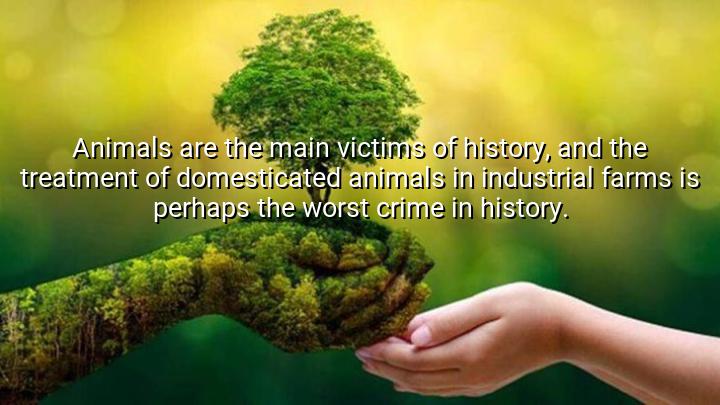




In this quote, Yuval Noah Harari asserts that animals have been among the most exploited and victimized groups in history, particularly in the context of their treatment in industrial farms. Harari argues that throughout history, animals have often been treated as mere tools for human benefit, subjected to suffering, domination, and exploitation. He specifically points to the modern industrial farming system as one of the most egregious forms of this exploitation, where animals are often kept in inhumane conditions for the purpose of mass production.
Harari’s statement calls attention to the ethical implications of how humans treat domesticated animals, particularly in large-scale agricultural operations. The industrialization of farming, with its emphasis on efficiency and profit, often results in practices that cause significant harm to animals, such as overcrowding, confinement, and mistreatment. By describing this as "perhaps the worst crime in history," Harari suggests that the scale of suffering inflicted on animals in these systems is unprecedented, given the sheer number of animals involved and the intensity of the cruelty they endure.
The origin of this quote is found in Harari’s broader work as a historian and philosopher, especially in his best-known book Sapiens: A Brief History of Humankind. In his writing, Harari frequently explores the relationship between humans and other species, emphasizing the power dynamics and ethical considerations that have shaped our treatment of animals. His views are informed by his research into the history of human civilization and its impact on both the natural world and the creatures within it.
Ultimately, Harari’s quote challenges the reader to reconsider the way animals are treated in the modern world, especially in industrial agriculture. By framing the mistreatment of domesticated animals as a historical crime, he encourages greater awareness and responsibility toward animals, urging society to reflect on the moral cost of our consumer habits and the ethical treatment of sentient beings.

AAdministratorAdministrator
Welcome, honored guests. Please leave a comment, we will respond soon