

The only hope is that our civilization will collapse at a certain point, as always happens in history. Then, out of barbarity, a renaissance.
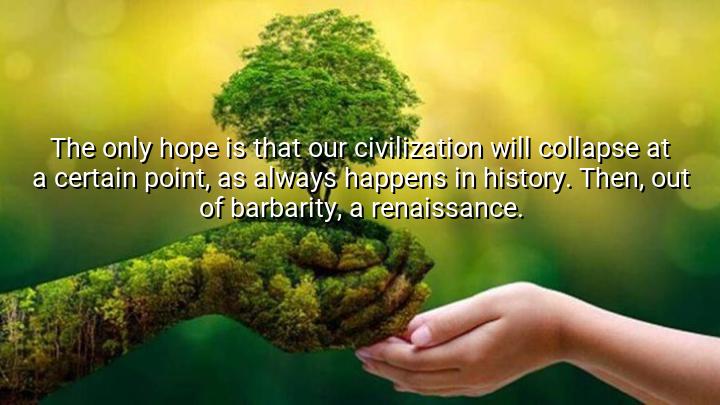




In this quote, Pierre Schaeffer, a French composer and musicologist, reflects on the cyclical nature of civilization and its inevitable decline. He suggests that throughout history, civilizations have risen and fallen, with each collapse followed by a renaissance—a period of rebirth or cultural flourishing that emerges from the chaos of decline. Schaeffer expresses a somewhat pessimistic view of the future, believing that the only hope for renewal lies in the complete collapse of current societal structures, which will pave the way for a new era of creativity and cultural growth.
Schaeffer’s statement taps into a historical perspective where the decline of great civilizations, such as the Roman Empire, was followed by the Renaissance, a time of renewed intellectual and artistic achievement. He suggests that this pattern is an inevitable part of history: societies reach a point of decay or barbarity, and from that point, new ideas and progress can emerge, transforming the world into something renewed and revitalized.
The origin of this quote can be found in Schaeffer’s broader work in the fields of music and philosophy, where he often explored the relationship between society, technology, and art. As a pioneer of acousmatic music (a genre focused on the sounds themselves, rather than their sources), Schaeffer was deeply invested in understanding how technological changes influence culture. His view that a collapse may lead to a renaissance can be seen as an expression of his belief in the transformative power of adversity.
Ultimately, Schaeffer’s words reflect a belief in the cyclicality of human history, where periods of destruction and decay make way for new ideas and cultural growth. He suggests that only after a society reaches its breaking point can it rebuild itself through renewal and creativity, much like a phoenix rising from the ashes. This perspective challenges us to consider the potential for rebirth even in times of crisis.

AAdministratorAdministrator
Welcome, honored guests. Please leave a comment, we will respond soon