

I do not want art for a few any more than education for a few, or freedom for a few.
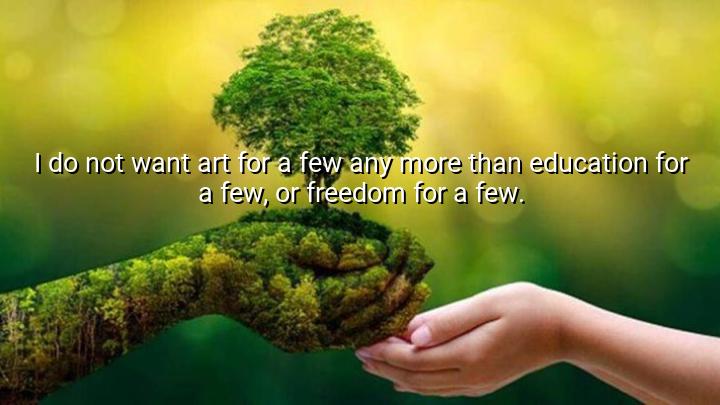




The quote "I do not want art for a few any more than education for a few, or freedom for a few" by William Morris reflects his belief in the democratization of cultural and intellectual resources. Morris, an advocate for social reform, emphasizes that art, like education and freedom, should be accessible to everyone, not just an elite or privileged few. He envisions a world where these essential aspects of human experience are available to all individuals, regardless of social or economic status.
Morris, a prominent figure in the Arts and Crafts Movement, was deeply committed to the idea that beauty and creativity should not be confined to the upper classes. He believed that art should enrich the lives of all people and that it could play a vital role in improving society as a whole. In this quote, he is aligning art with other fundamental rights such as education and freedom, suggesting that these should not be exclusive privileges but universal needs.
The origin of this quote is rooted in Morris's advocacy for social change. His works and writings often focused on the importance of equality, access, and the potential of art to elevate society. He was critical of industrialization and the ways in which it separated people from the craftsmanship and creativity that he believed were vital to a fulfilling life. Morris's vision was one of a society where artistic expression was not only accessible but integrated into daily life.
For Morris, this quote serves as a call to action. He challenges the notion that art should be reserved for the elite and stresses that, just like education and freedom, it is something that should belong to everyone. His words remind us that cultural enrichment and personal empowerment through artistic expression are rights that should be accessible to all people, fostering a more inclusive and equal society.

HNHanh Nguyen
I find this quote incredibly inspiring, but I wonder—how much responsibility lies with institutions versus individual artists? Should artists actively try to make their work more accessible, or is it up to governments and cultural organizations to ensure broad access? And what does ‘access’ really mean—financial affordability, cultural relevance, geographic availability? It feels like there are many layers to unpack here, and no simple answer.
TANguyen Ngoc Truc Anh
This quote makes me feel both hopeful and frustrated. Hopeful because it clearly champions equality, but frustrated because we’re still so far from that vision. How can we make sure art doesn’t become something reserved for gallery spaces and collectors? Should we redefine what counts as ‘art’ so that more forms of creativity—like graffiti, street performance, crafts—are seen as equally valid? Maybe the problem is also in how we value different types of expression.
HLHoang Linh
Morris’s words feel timeless. They make me think about how art often ends up in the hands of the privileged—those who can afford to make it, buy it, or study it. But shouldn’t everyone have the chance to express themselves creatively, regardless of class or background? I’d love to hear thoughts on how public funding, community arts centers, or even digital tools could level the playing field. What’s the modern-day path to art for all?
VPHuynh Vinh Phat
I love the spirit of this quote, but I’m curious—how realistic is it today? Even with the internet and open platforms, there's still a massive gap in access to materials, time, and training. Not everyone can afford to create or consume art. Is it enough to want art for all, or does society need to fundamentally change its priorities in order to make that happen? It feels like a revolutionary challenge.
PTPham Tran
This quote speaks so powerfully to the idea of art as a human right, not a luxury. It makes me wonder—why is access to art still so limited in many communities? Museums charge high fees, arts education is often the first thing cut from school budgets, and the art world itself can feel incredibly elitist. How do we begin to create a world where creativity is as accessible as public education or voting rights?