

History has remembered the kings and warriors, because they destroyed; art has remembered the people, because they created.
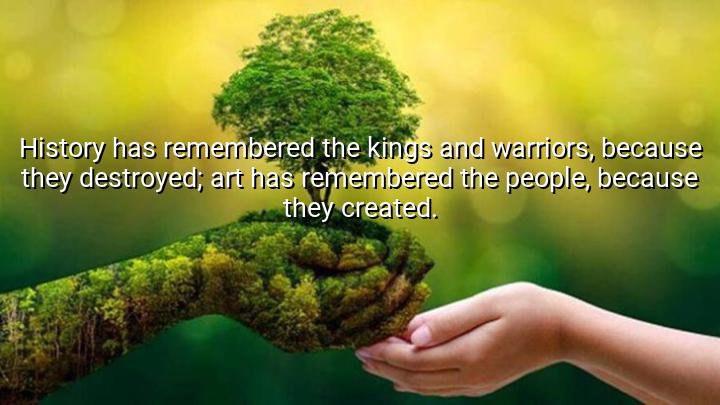




In this quote, William Morris contrasts the way history remembers kings and warriors versus artists and creators. He suggests that kings and warriors are often remembered for their destruction—through battles, wars, and conquests—because their actions typically resulted in significant, sometimes violent, change. However, art remembers the people who contributed to human progress not through violence, but through creation—whether it be in the form of art, literature, architecture, or other creative endeavors.
Morris highlights the idea that destruction might capture the immediate attention of history, but it is the act of creation that endures. While kings and warriors may leave behind a legacy of power or territorial expansion, it is the work of creators that leaves a lasting imprint on culture and society. Their contributions—often born of imagination, innovation, and expression—are what shape the identity of humanity, influencing generations long after their time.
The quote also touches on the value of the individual in history. Whereas the narratives of kings and warriors are often written in terms of power and domination, the contributions of artists reflect the human spirit and the drive to express, communicate, and create something that transcends time. Morris emphasizes that creators—whether painters, writers, or craftsmen—have a more enduring influence on humanity than those who engage in conquest and destruction.
Ultimately, Morris’ statement invites a reflection on the legacy of human action. It calls attention to how we choose to remember history, suggesting that while destruction may have immediate consequences, it is creation that truly shapes the course of civilization and is remembered for its lasting impact on society and culture.

NNanh nguyen ngoc
Reading this quote, I feel a sense of justice—it’s comforting to think that creators, not destroyers, are ultimately remembered in more meaningful ways. But in our current world, where conflict still dominates headlines, is art strong enough to shift collective memory over time? Can creation really compete with the spectacle of destruction, especially in an age of social media where shock value often wins?
MMinh
I find this quote empowering—it feels like a tribute to ordinary people whose lives and labor often go unacknowledged. But it makes me question: what role does storytelling play in both history and art? Aren’t they both narratives shaped by perspective? Could it be that art is simply another form of history, but told with feeling instead of facts? If so, which version of the past do we trust more?
TGNguyen Thi Tra Giang
There’s something poetic about the way Morris flips the script on historical memory. Still, I can’t help but feel conflicted. Isn’t it often through the lens of war, tragedy, or destruction that some of the most powerful art is made? Does that mean destruction fuels creation, and the two aren’t as opposed as the quote suggests? It’s a beautiful sentiment, but maybe a bit idealized in practice.
QQQuynh Quynhh
I really love this quote—it feels like a quiet rebellion against the glorification of violence and dominance. But I do wonder, does art actually have the same enduring power to preserve memory as history books? With so much emphasis on facts and figures in education, are we really teaching future generations to value the creativity of everyday people, or are we still stuck in the stories of rulers and empires?
TTtung le thanh tung
I find Morris's perspective deeply moving. It celebrates the idea that true legacy lies in creation, not conquest. But it also raises a question: who decides what art gets remembered? Isn't it still influenced by power structures and institutions, much like history itself? Maybe the people are remembered through art, but is that art chosen and preserved democratically, or is it curated by elites just like historical narratives?