

Grab the broom of anger and drive off the beast of fear.
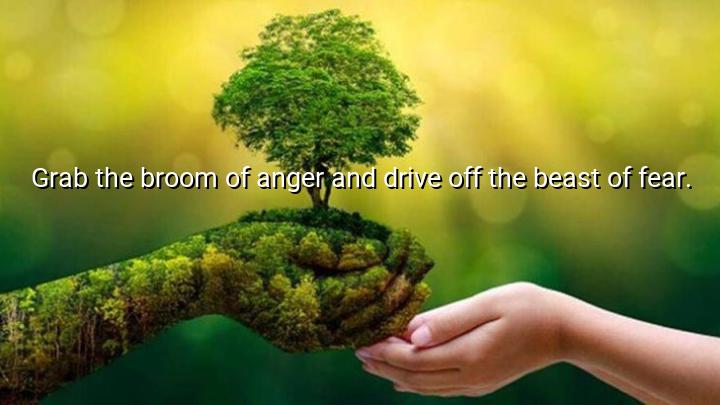




In this quote, Zora Neale Hurston uses vivid imagery to convey the idea that anger can be a powerful tool to overcome fear. The "broom of anger" symbolizes an active force that can sweep away the paralyzing effects of fear, represented as a "beast." Hurston suggests that by confronting fear with the energy and courage that anger can provide, we can clear the obstacles that hold us back and take control of our lives.
The phrase "drive off the beast of fear" emphasizes the idea of fear as a wild, uncontrollable force, like a beast that looms over us. Anger, when channeled properly, can become a force of empowerment, propelling us to act against the paralysis that fear induces. Hurston is suggesting that rather than being consumed by fear, we can use the raw energy of anger to overcome it and move forward.
Hurston’s quote reflects her broader themes of self-empowerment and resilience. As a writer who often dealt with issues of race and identity, Hurston understood that fear could be a powerful force that keeps people from achieving their potential. By invoking anger as a tool to combat fear, she encourages individuals to take control of their emotions and use them as motivation to fight against societal and personal fears that hold them back.
Ultimately, Hurston is advocating for the idea that anger can be harnessed for strength and liberation. Instead of allowing fear to dictate your actions, using anger strategically can help you regain control and courage. The quote encourages us to not shy away from our emotions, but to use them to fuel our own growth and overcome the fears that limit us.

PQTran Phuong Quynh
The imagery here is vivid—the broom sweeping away the ‘beast’ of fear. But I wonder, is anger always the best weapon? Could other emotions, like hope or love, be more effective in dispelling fear? Or is anger uniquely powerful because it demands action? It would be interesting to examine cultural perspectives on this, as some traditions emphasize calmness over anger as a path to courage.
VAViet anh
This statement makes me think about social movements and personal struggles alike. Anger often fuels resistance against injustice, while fear can paralyze. Does this mean anger is necessary for progress? But what happens if anger overtakes reason and compassion? Could this lead to destructive outcomes? I’m curious about the ethics of using anger as a driving force and how to temper it so it truly serves us in overcoming fear.
TTThanh Tran
What fascinates me is the suggestion that fear can be confronted head-on, not by calmness or reason, but through anger. Is this a call to embrace our passionate emotions to gain courage? Or is it a reminder that fear itself breeds passivity, and anger might be the spark needed to ignite change? I’d be interested in hearing how others interpret the interplay of these two powerful emotions in their lives.
LTLinh Trieu
I find the metaphor of ‘driving off fear’ with anger compelling, yet it raises questions about balance. Is anger always a reliable tool to combat fear, or can it sometimes mask or worsen it? How do we differentiate between righteous anger that motivates action and anger that blinds us to real risks? It makes me wonder if this advice applies universally or depends on individual temperament and context.
CMHoang Cong Minh
This quote really flips the usual idea that anger is destructive. Here, anger is portrayed as a weapon against fear. Could it be that harnessing anger constructively empowers us to overcome our deepest anxieties? But how do we ensure anger doesn’t become the very beast we’re trying to fight? I’d love to explore how one can channel anger positively without letting it consume or distort our judgment.