

First and foremost, we need to be the adults we want our children to be. We should watch our own gossiping and anger. We should model the kindness we want to see.
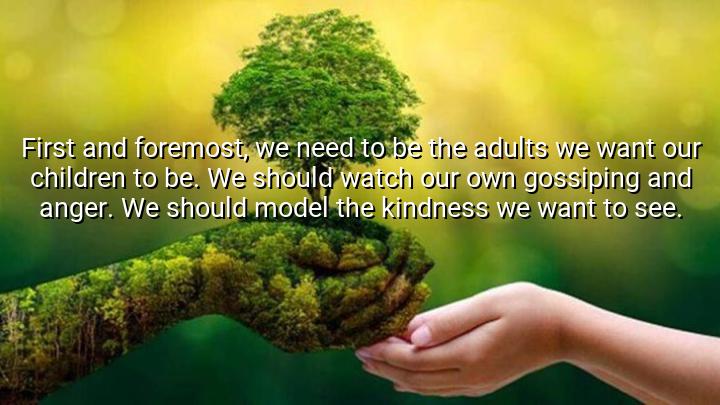




Brene Brown’s quote highlights the significant responsibility of adults to set a positive example for children. She emphasizes that in order to shape future generations, we must first embody the traits and behaviors we hope to see in them. The phrase "we need to be the adults we want our children to be" speaks to the power of modeling good behavior in everyday life.
The quote stresses the importance of being mindful of actions such as gossiping and anger. Brown calls attention to the fact that children often learn by observing the behavior of the adults around them. Therefore, if we exhibit negative behaviors like gossiping or uncontrolled anger, we inadvertently teach children to do the same. By curbing these tendencies, we set a healthier example for them to follow.
Moreover, Brown advocates for modeling kindness. This is a key point in her philosophy, suggesting that positive actions, such as showing compassion and empathy, are critical in fostering a healthy emotional environment. Children tend to mimic what they observe, and when adults model kindness, it encourages the same behavior in future generations.
Ultimately, the quote serves as a reminder that the best way to influence others, especially children, is through our actions, not just our words. By practicing what we preach, we create a culture of respect and kindness that will ripple through generations, ensuring a brighter, more compassionate future.

NANgoc Anh
I find it powerful that this quote connects adult behavior directly to children’s development. It challenges me to examine my own habits—am I inadvertently modeling gossip or impatience? How can workplaces and communities encourage adults to embody the kindness and patience we want to see in the next generation? This highlights the collective responsibility we share in shaping society’s future.
HAHoang Hong Hai An
This statement makes me reflect on the pressure adults face to ‘set an example.’ Is this pressure motivating or overwhelming? How do adults navigate their own emotional struggles while trying to model kindness consistently? I wonder if part of being a good role model also involves showing children how to deal with anger constructively rather than hiding it completely.
HNHao Nhat
Reading this, I’m struck by how easy it is to overlook the impact of subtle behaviors like gossip on children’s attitudes. It raises a question: How much of societal negativity is passed down through these small, everyday actions? If we consciously reduce gossip and anger, could that ripple out to broader cultural change? It makes me hopeful about the potential for individual actions to influence future generations.
HMHoang Ho manh
I love the emphasis on kindness as something to actively model. It makes me question how many adults underestimate the power of their everyday interactions on children’s development. Does modeling kindness also mean showing vulnerability and admitting mistakes? How do children respond when adults demonstrate both kindness and accountability? This quote encourages a more holistic view of what it means to ‘be the adults we want our children to be.’
LPBui Thi Linh Phuong
This quote feels like a call to personal accountability in parenting and leadership. I’m curious how adults can effectively monitor behaviors like gossip or anger, which can be so ingrained and subconscious. Are there strategies or practices that help adults stay conscious of the example they set? It also makes me think about how kindness can be authentically modeled in challenging situations.