

Death be not proud, though some have called thee Mighty and dreadful, for thou art not so. For, those, whom thou think'st thou dost overthrow. Die not, poor death, nor yet canst thou kill me.
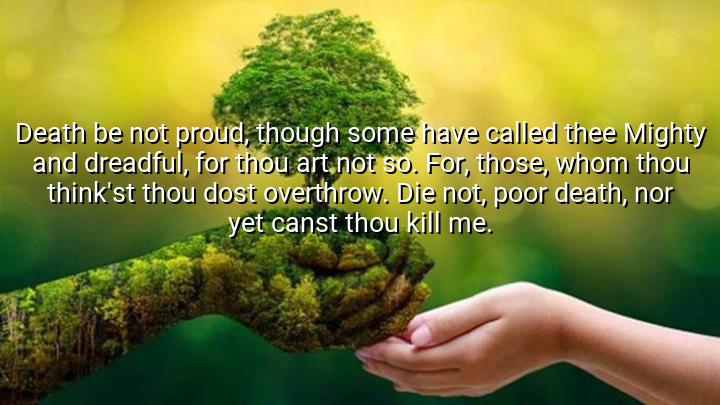




The quote "Death be not proud, though some have called thee Mighty and dreadful, for thou art not so. For, those, whom thou think'st thou dost overthrow. Die not, poor death, nor yet canst thou kill me" by John Donne is a powerful declaration against the fear and reverence traditionally associated with death. Donne, a 17th-century poet and clergyman, wrote this in his poem "Death Be Not Proud," where he personifies death as an arrogant figure that believes it has ultimate power over humanity. Donne challenges this belief, arguing that death is not as powerful or frightening as it seems.
By saying, "Death be not proud," Donne diminishes the pride often attributed to death. He argues that although many consider death to be mighty and dreadful, it is not truly so. He points out that those who death claims do not truly die; instead, their souls live on, meaning death cannot truly "overthrow" them or destroy them. Donne emphasizes the idea that death is not an end but a transition, challenging its traditionally feared and awe-inspiring nature.
The phrase "Die not, poor death" is a direct confrontation of death itself. Donne uses the word "poor" to diminish death's significance, portraying it as a powerless and misunderstood force. The poet suggests that death is not capable of truly killing or overpowering the human spirit. By rejecting the finality of death, Donne expresses a belief in the immortality of the soul, an idea that was central to his Christian faith.
In essence, Donne's quote is a defiant rejection of death as a source of fear and sorrow. Through this argument, he elevates the concept of eternal life, asserting that death may claim the body, but it cannot destroy the soul. His bold and philosophical words invite readers to confront death with courage and understanding, rather than with fear and submission.

MNLe Thi My Nguyet
There’s something incredibly intimate about this declaration. It’s as if Donne is speaking directly to death—not fearing it, but confronting it with reason and faith. I’m intrigued by how literature often tries to demystify or even humiliate death. Is this just metaphorical courage, or do you think poets like Donne genuinely felt this brave about dying? How much of this is belief versus artistic performance?
UGUser Google
Donne’s words remind me of how poetry can reframe fear into something noble. His challenge to death feels like a personal victory over anxiety, maybe even a victory for all of us. But I do wonder—does this kind of poetic bravado comfort people in grief, or does it risk feeling disconnected from the pain of loss? Can literary courage actually soothe real mourning?
UPTruong Thai Uyen Phuong
I find the tone here really compelling—almost taunting. It makes me ask, why is death so often personified? Is it to make it more manageable or less mysterious? Donne seems to reduce it to a mere illusion. Does stripping death of power this way help us live more fully, or is it a form of denial? I’d love to hear different perspectives on this rhetorical stance.
Ggiang
This passage hits me hard. It’s bold, unapologetic, and strangely empowering. I think Donne is reclaiming control from the fear that death usually instills. But does this kind of courage only come from deep belief in something greater, like eternal life? Or can one develop that strength from sheer conviction or reason? I’m curious what people think fuels that kind of spiritual confidence.
MTBui Minh Thu
John Donne’s defiance of death here is fascinating. It feels like a spiritual protest—almost daring death to try and assert its power. Is this rooted in religious faith, or is it more of a philosophical argument? I wonder how someone not religious might interpret this. Can the idea of mocking death’s power still resonate with people who don’t believe in an afterlife?