

No spring nor summer beauty hath such grace as I have seen in one autumnal face.
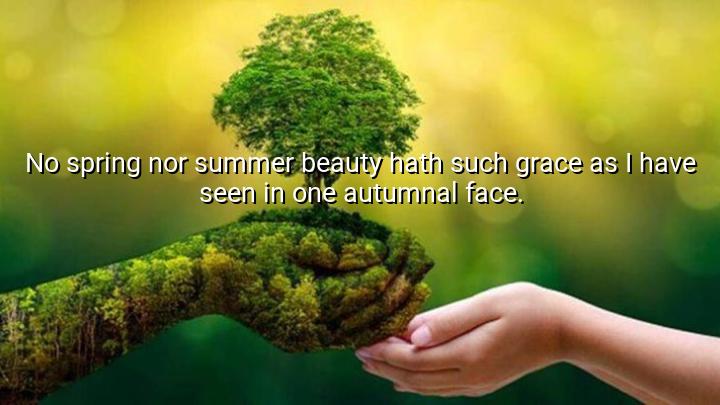




In this quote, John Donne, a famous English poet, presents a deep reflection on the concept of beauty and its various forms. He suggests that no beauty associated with spring or summer, typically seen as times of vibrancy and renewal, can match the grace he observes in an autumnal face. Autumn, often symbolizing maturity, wisdom, and the passage of time, holds a more profound beauty in Donne’s eyes. The "autumnal face" represents a beauty that comes with age and experience, qualities that are deeper and more enduring than the youthful vitality associated with the earlier seasons.
Donne’s comparison between the seasons of the year and the phases of life points to a view of beauty that transcends superficial appearances. While spring and summer may be associated with physical vitality and freshness, autumn's beauty is tied to the soul and character that have developed over time. The "autumnal face" suggests that beauty can be found in the lived experiences and wisdom of a person, giving it a grace that is more lasting and intimate than youthful beauty.
The origin of this quote can be found in Donne’s poetry, which often explored themes of love, time, and transience. Donne’s works were deeply philosophical, often reflecting on the impermanence of life and the deeper aspects of human existence. This quote is in line with his broader view that beauty evolves and that grace is not confined to youth or idealized appearances but can emerge from the aging process, making it a more meaningful and enduring form of beauty.
Ultimately, Donne’s quote serves as a celebration of the grace and wisdom that come with age and experience, positioning the beauty of an autumn-like phase of life as superior to the fleeting beauty of youth. It reminds us that true beauty is not solely defined by physical traits, but also by the richness of character and the depth that time and experience bring to a person’s life.

AAdministratorAdministrator
Welcome, honored guests. Please leave a comment, we will respond soon