

Any man's death diminishes me, because I am involved in Mankind; And therefore never send to know for whom the bell tolls; it tolls for thee.
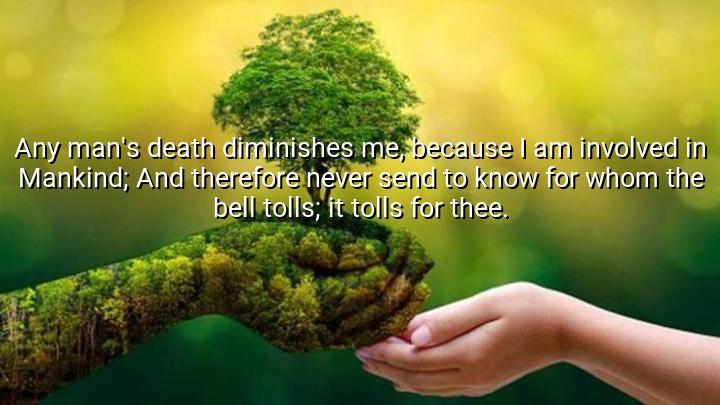




John Donne’s quote, "Any man's death diminishes me, because I am involved in Mankind; And therefore never send to know for whom the bell tolls; it tolls for thee," expresses the profound interconnectedness of humanity. Donne is emphasizing that the death of any individual affects all of us, as we are all part of a greater collective, Mankind. Rather than viewing death as an isolated event, Donne suggests that every loss is shared, and we all experience its impact, even if indirectly. The idea of being involved in Mankind suggests a deep sense of solidarity and shared human experience.
The quote also speaks to the futility of distancing oneself from others' suffering, particularly through the famous phrase "for whom the bell tolls." Historically, church bells would toll to announce a death, and Donne’s words suggest that when anyone dies, it is as if the bell tolls for each of us. The bell symbolizes the reminder that we are all part of a larger human experience, and no one is exempt from the reality of mortality. Donne argues that the death of another is not just a distant event but something that affects us all, reminding us of our shared humanity.
John Donne, an English poet and cleric, was known for his exploration of death, love, and existential themes in his works. This quote is from his meditation "For Whom the Bell Tolls," in which he reflects on the nature of life and death. Donne’s perspective on death was shaped by his Christian beliefs and his understanding of the interconnectedness of all souls. His meditation calls for compassion and empathy, urging individuals to recognize that the loss of any life is significant because it speaks to the vulnerability and preciousness of our own existence.
The origin of this quote is found in Donne’s Meditations, which were written as spiritual reflections during a period of illness. The meditations reflect on life’s fragility and the need to embrace the idea of unity within the human condition. Donne’s deep sense of connection to humanity made him see death not as a personal tragedy but as a shared event that reminds everyone of their mortality and place in the world. This quote is a powerful call for compassion and recognition of our collective existence.

AAdministratorAdministrator
Welcome, honored guests. Please leave a comment, we will respond soon