

Behind every argument is someone's ignorance.
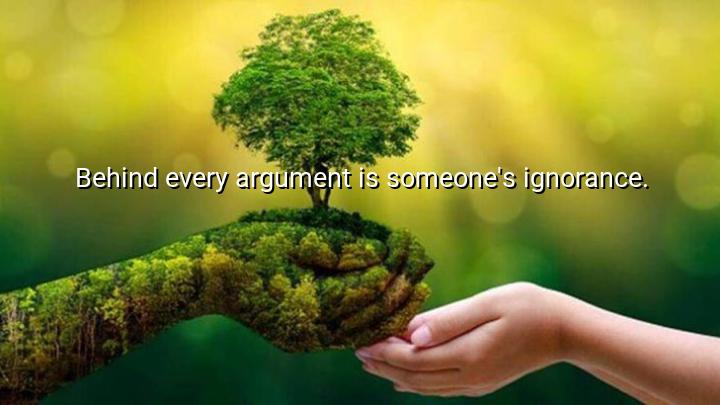




The quote by Louis D. Brandeis — "Behind every argument is someone's ignorance." — suggests that many conflicts or disagreements stem from a lack of understanding or knowledge. According to Brandeis, people often argue because they are not fully informed or are relying on limited information. Instead of seeking mutual understanding, they dig in their heels, driven by ignorance about the other person's perspective or the full scope of the issue at hand.
Brandeis’ insight points to the idea that arguments are frequently fueled by a lack of awareness or misperception. When individuals do not understand the complexity of a situation or fail to consider other viewpoints, they resort to argument as a defense mechanism. This ignorance prevents productive dialogue and escalates conflict, as each party feels the need to assert their position without truly listening or understanding the other side.
This quote aligns with Brandeis’ broader philosophy about the importance of education and understanding in resolving disputes. He believed that when people are more informed and open-minded, they are less likely to engage in unproductive arguments. By embracing knowledge and understanding, individuals can avoid the negative impact of ignorance and engage in more thoughtful, constructive conversations.
Ultimately, Brandeis’ words remind us that arguments often reveal more about our own lack of understanding than they do about the issue at hand. Instead of focusing on defending our position, we should strive to listen, learn, and engage with an open mind to avoid the cycle of ignorance that fuels conflict.

OKOri Kim
Reading this, I’m reminded that arguments often reflect a lack of shared understanding. How can we create spaces for constructive dialogue that reduce ignorance rather than deepen divides? Does this perspective encourage us to approach conflicts with curiosity rather than judgment? It would be interesting to explore real-life examples where education and empathy transformed contentious debates.
NTKhanh Ly Nguyen Thi
This quote makes me consider how social and cultural factors contribute to ignorance that leads to arguments. Are certain environments or education systems more prone to fostering ignorance? How can communities work together to promote critical thinking and awareness? It also raises the question of responsibility—how much should individuals versus society work to reduce ignorance?
AFFan Chinh Chu Anh Ford
Brandeis’ insight highlights the importance of understanding in resolving arguments. How do we approach someone’s ignorance without offending or alienating them? Can humility and patience in conversations help reveal and bridge knowledge gaps? I’m curious about the balance between challenging ignorance and respecting different viewpoints in a diverse society.
ANAnna Nguyen
I find this quote thought-provoking because it frames ignorance as the root of conflict. Could addressing ignorance through dialogue and education prevent many disputes? What role does cognitive bias play in perpetuating ignorance even when facts are available? This idea challenges us to look beyond surface disagreements to the knowledge gaps underneath.
VVyyyy
This statement implies that ignorance underlies most disputes, but I wonder if that’s always true. Can there be arguments based on informed but differing opinions rather than ignorance? How do we distinguish between ignorance and genuine disagreement? It raises questions about empathy and open-mindedness as tools to bridge divides in conversations and debates.