

Be careful that you do not write or paint anything that is not your own, that you don't know in your own soul.
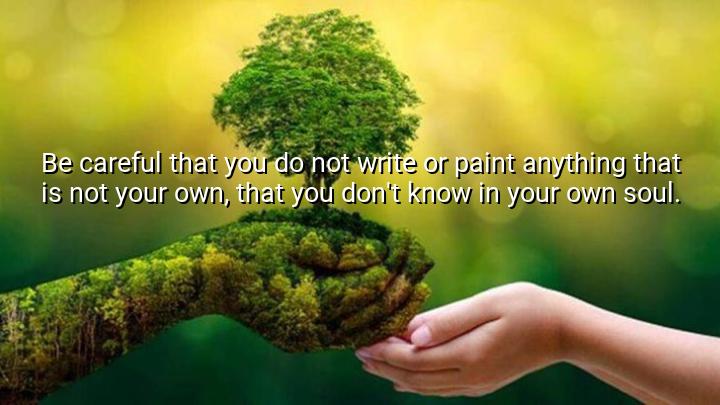




The quote "Be careful that you do not write or paint anything that is not your own, that you don't know in your own soul" by Emily Carr speaks to the importance of authenticity and personal connection in the creative process. Carr, a Canadian artist and writer known for her depictions of Indigenous life and the natural landscape, emphasizes that art must come from a place of genuine understanding and personal experience. To create something meaningful, the artist must draw from their own soul, ensuring that their work is a true reflection of their thoughts, emotions, and unique perspective.
Carr warns against imitating or appropriating ideas that are not one's own. In her view, creating something that lacks personal knowledge or connection can result in superficial work that lacks depth or sincerity. By focusing on what resonates within the artist's own soul, the work will be more authentic, powerful, and true to the artist's vision and understanding of the world. The quote encourages artists to be true to their own experiences and insights rather than relying on external influences that don’t reflect their inner truth.
This idea also ties into the notion of art as a deeply personal form of expression. Carr believed that art should come from the heart, not from what is fashionable or externally expected. The artist’s own experiences, emotions, and understanding of life are what give the work its true value and resonance. Art that is deeply rooted in the artist's own soul can speak to others on a more profound level, as it communicates universal truths born from personal authenticity.
Ultimately, Carr’s quote serves as a reminder for artists to maintain integrity in their work. It highlights the idea that true artistic expression arises when creators stay grounded in their own soul, ensuring that what they produce is both meaningful and personal. This approach leads to work that is not only genuine but also emotionally impactful, as it reflects the artist's innermost self.

QDquyen dang
Carr’s warning brings up an interesting thought: is it possible for an artist to unintentionally misrepresent something they don't fully understand? If an artist attempts to portray something they haven't experienced firsthand, could it ever be seen as disingenuous? Or do we simply need to trust in an artist’s interpretation, even if it doesn’t come from their soul, as long as the work holds emotional value?
Mmy_le
This quote feels like a reminder of the importance of honesty and self-awareness in art. But, does this mean that an artist is limited to creating only based on their personal experiences and emotions? How do artists who experiment with completely new perspectives, cultures, or imaginary worlds fit into this idea? Can an artist truly create something meaningful without having direct, personal knowledge of the subject?
DQPham Duy QUat
Carr’s advice seems to put a lot of pressure on artists to only create from what they fully know. Does this imply that artists should never venture into unknown or unfamiliar territory? Can an artist explore new ideas and emotions through their work, even if it’s not something they have lived or directly experienced? How do you balance staying true to yourself while still pushing the boundaries of creativity?
CTNguyen Cong Thanh
This quote resonates deeply with me, but it also makes me question what it means to truly 'know' something in your own soul. Can artists ever really fully know what they create, especially when it involves emotions, abstract concepts, or other people's perspectives? Do we risk misrepresentation or inauthenticity if we step outside of our own experiences and try to convey something we don't fully understand?
TTNguyen Ngoc Tay Thi
I really appreciate Carr's caution here. She’s encouraging authenticity in art, but how does this apply to artists who create works based on research or other people's experiences? Is it still 'authentic' if it doesn’t come directly from the artist's own soul? I wonder, though, can an artist still create something meaningful by interpreting the world of others, or does it risk losing that personal connection?