

I sat staring, staring, staring - half lost, learning a new language or rather the same language in a different dialect. So still were the big woods where I sat, sound might not yet have been born.
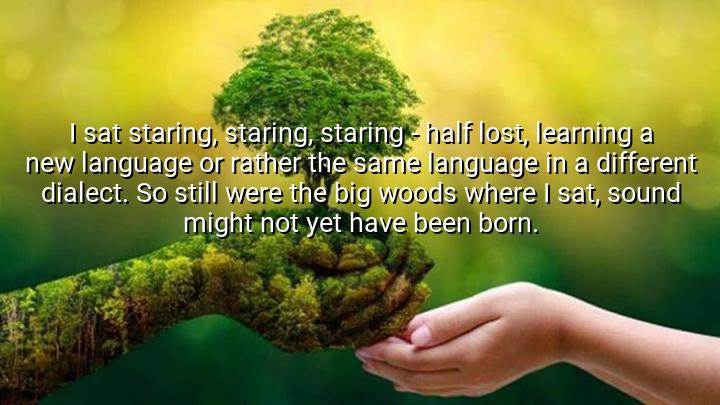




The quote by Emily Carr, "I sat staring, staring, staring - half lost, learning a new language or rather the same language in a different dialect. So still were the big woods where I sat, sound might not yet have been born," emphasizes the intimate connection between observation, learning, and the natural world. Carr reflects on the process of learning to perceive deeply, suggesting that understanding nature requires patience, attention, and an openness to new forms of communication and expression, even when it seems subtle or silent.
The origin of this quote comes from Carr’s life as a Canadian artist and writer, renowned for her depictions of the West Coast forests and Indigenous culture. Her work often explored the relationship between humans and nature, portraying the spiritual and sensory experience of the landscape. This reflection illustrates her dedication to learning from the environment, approaching it as a teacher that communicates in its own unique language.
The quote also underscores the idea that learning is immersive and contemplative. Carr suggests that deep understanding comes not from rushing or forcing knowledge, but from being present and attentive, allowing the language of the world—whether nature, culture, or art—to reveal itself gradually. This approach highlights the role of observation, patience, and reflection in meaningful learning.
Ultimately, Carr’s words inspire a mindset of curiosity, mindfulness, and receptivity. They remind us that learning is not only about formal study but also about attuning to the subtle, often silent lessons offered by our surroundings. By embracing this form of learning, individuals can develop insight, sensitivity, and a profound appreciation for the richness of life and the world around them.

AAdministratorAdministrator
Welcome, honored guests. Please leave a comment, we will respond soon