

You come into the world alone and you go out of the world alone yet it seems to me you are more alone while living than even going and coming.
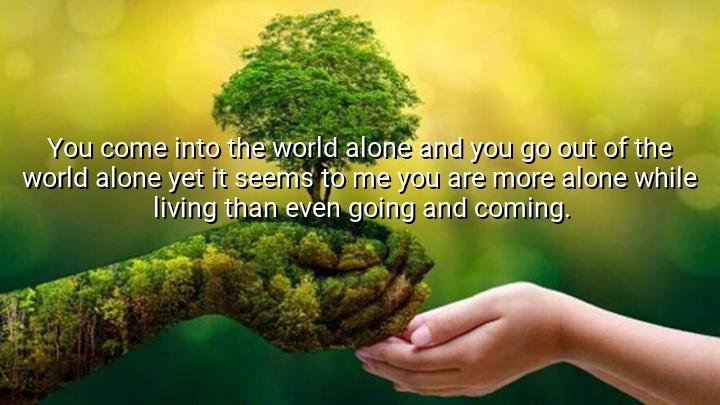




The quote "You come into the world alone and you go out of the world alone yet it seems to me you are more alone while living than even going and coming" by Emily Carr speaks to the profound sense of isolation that can exist during one’s life. While birth and death are often seen as the loneliest experiences, Carr suggests that living itself—navigating the complexities of existence, thought, and emotion—can bring an even deeper feeling of aloneness.
Emily Carr, a pioneering Canadian artist and writer, was known for her introspective nature and strong connection to nature and spirituality. Living much of her life in solitude and often misunderstood by her contemporaries, Carr developed a deep awareness of the inner self. This quote likely stems from her own experiences of feeling disconnected from others, even while physically present in the world.
The line highlights a difference between physical and emotional solitude. While being born or dying might appear to be solitary moments, there is a quiet suggestion that those transitions are perhaps more natural, even peaceful, compared to the emotional isolation we can face during life—moments of not being truly seen, heard, or understood by others.
Ultimately, Carr’s words remind us of the human longing for connection and meaning amidst the silence of our individual paths. Her reflection invites us to acknowledge this deep aloneness, not with despair, but with honesty—and perhaps to find beauty and strength in accepting that part of the human condition.

Tthuthuong
Carr’s words stir something deep in me. If living is lonelier than being born or dying, does that mean our inner world is more isolating than we realize? Or maybe she's touching on the gap between our authentic self and the roles we play. Is the loneliness of life not physical, but spiritual—the sense of being unknown even in the midst of others?
Fftffycdtygftugfyigy
This feels like one of those lines you carry with you. It’s not just about solitude, but the emotional complexity of being human. Are we lonelier today because of modern disconnection, or was this always part of the human condition? Carr’s observation seems timeless, yet more relevant than ever. How do we respond to this kind of loneliness—resist it, numb it, or embrace it?
MDMy Dinh
What strikes me most about this quote is its honesty. Living comes with the illusion of closeness, but often a deeper sense of isolation. I wonder if this is why people chase fame, relationships, or success—hoping to fill that persistent gap. Is it ever truly possible to escape this aloneness, or is it something we must learn to live with gracefully?
LLinh
There’s a haunting truth to this line. We often talk about loneliness at the beginning and end of life, but what about the middle—the years where we’re surrounded by people but feel emotionally distant? This quote makes me question how much of our solitude is self-imposed. Is it possible that our internal barriers matter more than our external circumstances?
GGGiang Giang
Carr’s quote left me with a kind of aching recognition. Sometimes it really does feel like the act of living—despite relationships and community—can be the loneliest part. Is that because we carry thoughts and emotions no one else can fully understand? I wonder, is loneliness a permanent feature of being human, or something we only feel when we stop trying to connect deeply?