

Art is not a handicraft, it is the transmission of feeling the artist has experienced.
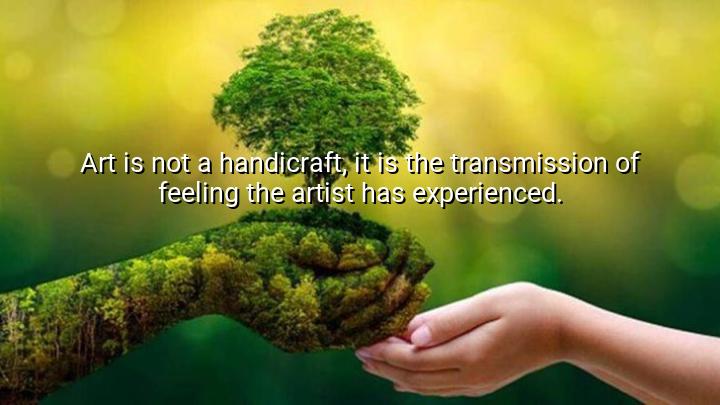




The quote "Art is not a handicraft, it is the transmission of feeling the artist has experienced" by Leo Tolstoy emphasizes the emotional and personal nature of art. Tolstoy, a Russian writer and philosopher, distinguishes art from mere handicraft, which is typically associated with technical skill or the creation of functional objects. Instead, he argues that art is about conveying the feelings and emotions the artist has experienced. The true value of art lies in its ability to communicate the inner emotional landscape of the creator to the audience.
Tolstoy suggests that art is a deeply human and emotional process. It is not simply about crafting something beautiful or functional; it is about expressing the artist's internal experiences. Whether through painting, music, writing, or any other medium, art becomes a vehicle for the artist to share their personal feelings, thoughts, and reflections with the world. This emotional transmission connects the artist and the viewer, creating a shared experience of understanding and empathy.
This perspective challenges the traditional view of art as a purely aesthetic or technical pursuit. Tolstoy’s definition places emphasis on the emotional and subjective experience of creating and experiencing art. It suggests that the power of art lies not in its physical execution but in the emotional depth it conveys, which resonates with the viewer on a personal level.
Ultimately, Tolstoy’s words remind us that art is a means of communication that goes beyond visual appeal or craftsmanship. It is a way for the artist to convey their emotional truth and for the audience to experience and reflect on those emotions. In this way, art becomes a universal language, transcending words and directly touching the human soul.

DDDuyen Dang
Tolstoy’s statement suggests that the true power of art lies in its ability to communicate emotion, not technique. But how do we measure the success of this emotional transmission? Does a painting or sculpture need to provoke a strong emotional response to be considered art? Can some works of art transmit subtle or complex feelings, or does the feeling need to be clear and direct to have an impact?
MNNguyen Minh Ngoc
Tolstoy’s quote makes me wonder: is it possible for art to transmit only the artist’s experience, or does the viewer’s perception inevitably alter that transmission? If art is truly the transmission of feelings, can a piece of art ever be fully understood as the artist intended? Or is the act of viewing it an interpretation influenced by the viewer’s own feelings and experiences?
TTHuong Trinh Thi Thu
I find it interesting that Tolstoy sees art as a medium for emotional transmission rather than craftsmanship. It suggests that the artist’s experience is the core of what makes the work meaningful. But do you think that art can convey universal emotions, or is it always tied to the artist’s individual experience? How can we interpret art if we don’t share the same emotional context as the artist?
TLThuy Lih
Tolstoy’s perspective challenges the traditional view of art as simply a craft or technical skill. He seems to argue that art is more about connecting with others through emotion. But what about abstract or conceptual art? Can those forms still transmit the artist’s feelings effectively, even if they’re not immediately emotionally accessible? Does the feeling always come through, or does it require a certain kind of openness from the viewer?
TMTinh Mai
Tolstoy’s view that art is a way of transmitting feeling makes me think about how personal and intimate art can be. It’s not just about creating something visually pleasing or skillful; it’s about sharing an emotional experience. But how much of the artist’s feeling actually makes it into the work? Can an audience ever truly feel what the artist felt? Or do we interpret the emotion through our own personal lens?