

Anger ventilated often hurries towards forgiveness; anger concealed often hardens into revenge.
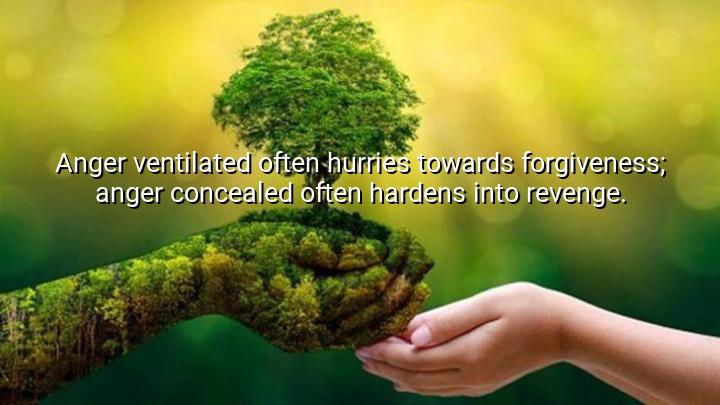




The quote by Edward G. Bulwer-Lytton — "Anger ventilated often hurries towards forgiveness; anger concealed often hardens into revenge." — explores the contrasting effects of expressing or suppressing anger. Bulwer-Lytton suggests that when anger is openly expressed or "ventilated," it can lead to emotional release and pave the way for forgiveness. By confronting the emotion directly, it is often resolved more quickly, allowing individuals to move past the situation. On the other hand, when anger is hidden or suppressed, it tends to fester and can eventually transform into revenge — a more destructive and prolonged emotion.
Bulwer-Lytton’s quote highlights the importance of emotional expression in maintaining healthy relationships and emotional well-being. Suppressing anger can prevent resolution, leading to a buildup of negative emotions that can harm both the individual and others. When anger is held in, it can become distorted over time, leading to feelings of resentment and the desire for revenge.
This idea reflects the broader psychological principle that suppressed anger tends to worsen over time, whereas expressing it helps prevent its escalation into harmful feelings. Forgiveness, in this context, is presented as the natural outcome of releasing anger in a healthy way. The quote suggests that anger, if dealt with appropriately, can actually promote healing and lead to the restoration of peace in a situation.
Ultimately, Bulwer-Lytton’s quote serves as a reminder that emotional honesty and self-expression are essential in overcoming negative emotions. By allowing anger to be expressed and addressed, we can avoid the more damaging outcomes of repressed anger, such as revenge. It encourages individuals to face their emotions directly, fostering understanding and forgiveness rather than letting the negative emotion grow into something more destructive.

DDdung dung
I’m struck by the idea that anger concealed hardens into revenge, which feels quite powerful. But does this mean that everyone who hides anger will eventually seek revenge? What about people who process their feelings internally but never act out negatively? It seems like the quote urges us to find safe outlets for anger, but I wonder how this applies in situations where expressing anger might not be safe or feasible.
DCChien Do dang chien
This quote suggests a strong link between communication and emotional healing. It makes me wonder about people who avoid confrontation because they fear conflict—are they at higher risk of harboring revenge? How might encouraging open dialogue in relationships prevent long-term bitterness? I’d be interested in hearing psychological perspectives on how suppressed anger can affect mental health and relationships.
NSNguyen Thi Ngoc Suong
I appreciate how this quote frames anger expression as a path to forgiveness, but I also feel concerned about the fine line between healthy ventilation and harmful outbursts. How do we teach emotional regulation so that expressing anger doesn’t turn into aggression? Could this be a lesson in emotional intelligence—using anger as a tool for resolution rather than destruction?
TLTam Le
This makes me reflect on my own experiences where hiding anger only made me resentful over time. I’m curious if this quote implies that forgiveness is a natural outcome of expressing anger honestly. Is that always true, or can venting sometimes deepen wounds? Also, are there cultural differences in how acceptable it is to express anger openly, and how might those differences affect forgiveness?
THVo Thanh Huy
I find this perspective quite insightful and a bit cautionary. It makes me think about how many conflicts escalate simply because people don’t communicate their feelings. But could there be risks to venting anger too freely? Might some people use it destructively rather than moving toward forgiveness? I’d love to discuss strategies for ensuring that airing anger leads to healing instead of further damage.