

In life, as in art, the beautiful moves in curves.
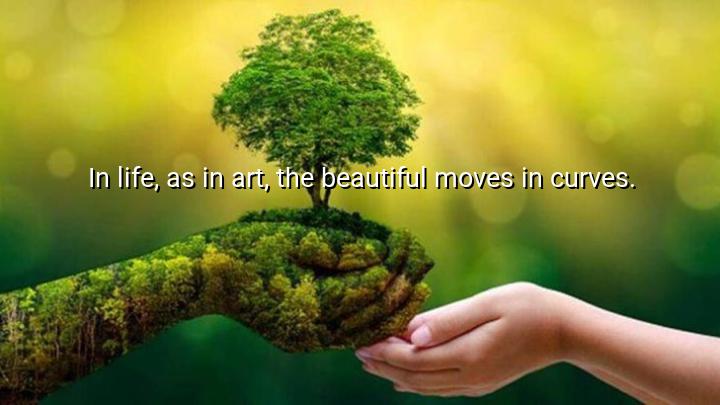




The quote "In life, as in art, the beautiful moves in curves" by Edward G. Bulwer-Lytton draws a parallel between the nature of life and art, suggesting that beauty is often found in fluidity and grace, rather than in rigid or straight lines. The use of curves in the quote symbolizes the natural, organic flow of life and artistic creation. Just as curves give a sense of softness and elegance in visual arts, life, too, is best understood and appreciated in its more dynamic, unpredictable moments.
Bulwer-Lytton, a 19th-century British writer, was known for his philosophical and literary works. Through this quote, he reflects on the idea that life, like art, is not always a straight path. It is filled with twists, challenges, and changes, much like the flowing, curving lines that often define aesthetically pleasing works of art. The curve, in this sense, represents a movement that is both gentle and powerful, evoking the richness and complexity of human experience.
The connection between life and art in the quote highlights the idea that both are forms of expression, each shaped by beauty and imperfection. Bulwer-Lytton suggests that to truly understand and appreciate life, we must embrace its complexity and fluidity, much like the way artists create works that often move away from the strictness of straight lines to achieve something more expressive and meaningful.
Ultimately, the quote calls for an acceptance of the non-linear nature of existence and creativity. It encourages us to recognize that beauty is not always about perfection or order, but about the natural, often unpredictable, curves that make life and art so deeply moving.

VTVy Thai
As someone who studies design, this quote speaks volumes. Curves evoke warmth, elegance, and motion, whereas straight lines often feel cold or forced. I love that Bulwer-Lytton brings this idea into life philosophy too. It makes me wonder: are we naturally drawn to what flows because it mirrors the rhythm of our emotions? Can embracing this in daily life lead to more empathy and creativity?
NKcao ngoc khanh
I find it interesting how this quote connects physical beauty with philosophical depth. It’s not just about aesthetics, but also about embracing imperfection and complexity. But I wonder, is there a danger in overly romanticizing the idea of ‘curves’ in life—like accepting unnecessary chaos or dysfunction? Where’s the line between graceful unpredictability and harmful instability?
HCLe Hoang Chau
Bulwer-Lytton’s words resonate with the natural world too—think of rivers, vines, or even the human body. Curves seem embedded in everything that feels alive and expressive. Is this just a poetic observation, or does it imply something deeper about how we should design our lives? Should we aim for more flow and less structure? I’m intrigued by how this could apply to education or urban planning.
Xxaximo
This quote really reminds me of how progress often isn't linear. It’s especially relevant in emotional healing or career development, where setbacks and twists can feel frustrating. But maybe those 'curves' are part of what makes the journey worth it. I wonder, does acknowledging this idea help people become more patient with themselves? It certainly gives me permission to move at my own rhythm.
AQle anh quyen
Is Bulwer-Lytton suggesting that both art and life achieve grace through fluidity and unpredictability? It makes me reflect on how rigidity—either in thought or behavior—often leads to stagnation, while adaptability leads to growth. I'm curious, though: can something angular or abrupt not also be beautiful? Must beauty always flow gently, or is that a romantic ideal imposed by aesthetics?