

Anger is one way to respond to fear. I say one way because responses are categorically multiple.
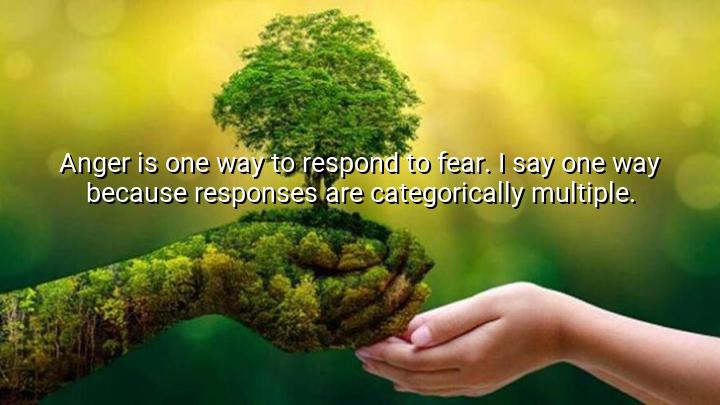




In this quote, Mark Z. Danielewski explores the connection between anger and fear, suggesting that anger is one possible response to fear, but not the only one. He acknowledges that human emotions are complex and that we have a range of ways to react to fear, each influenced by individual experiences, personality, and circumstances. By stating that "responses are categorically multiple," Danielewski highlights the diversity of emotional reactions that can arise in response to a single stimulus, like fear.
Danielewski’s perspective invites us to consider the different ways fear can manifest emotionally. While anger is one common reaction, it’s not universal. Some people may respond to fear with withdrawal, anxiety, or denial, while others might choose more constructive responses, like problem-solving or seeking reassurance. This idea challenges simplistic views of emotions, encouraging a deeper understanding of how people cope with fear in varying ways.
The quote also speaks to the fluid nature of emotional responses and how they are not fixed. The phrase "responses are categorically multiple" suggests that emotions, especially ones as primal as anger or fear, are not set in stone but rather part of a larger spectrum of human behavior. This recognition allows for a more nuanced approach to understanding how emotions influence our actions and relationships.
Ultimately, Danielewski’s quote sheds light on the complexity of emotional reactions, particularly in the face of fear. It suggests that while anger is a common response, it is just one of many possibilities. Understanding this can lead to greater empathy and insight into how individuals process fear and its associated emotions differently.

TKNgoc Doan Thu Kim
This quote highlights the fluid nature of emotions. Is it possible that someone’s response to fear changes depending on context, or is it more of a fixed trait? Understanding that anger isn’t the only option could be liberating, but also challenging. I’d like to hear thoughts on how individuals and communities can foster more adaptive emotional responses.
QLNguyen Quoc Linh
I’m curious about the implications of categorizing responses to fear. Could recognizing multiple responses empower people to shift from reactive anger to more constructive emotions like curiosity or compassion? How do you think this understanding might affect conflict resolution on both personal and societal levels?
HKHuong Hoang Kieu
The idea that fear can lead to multiple responses makes me wonder how we learn to respond in particular ways. Are some responses, like anger, learned from environment or genetics? How much control do people have in changing their default reactions to fear? Exploring this could provide insights into emotional growth and therapy.
KUNguyen Thi Kim Uyen
This quote opens up a broader conversation about emotional complexity. Do you think people are often unaware of the variety of ways they can respond to fear? How might cultural or personal factors influence which responses are most common? It would be useful to discuss how expanding our emotional vocabulary could improve emotional regulation and understanding.
TTTung Truong
I appreciate the recognition that anger is just one possible response to fear. What other reactions do you think are common, and how might they differ in effectiveness or impact? It’s interesting to consider whether anger is a protective mechanism or a way to mask vulnerability. I’d love to explore how awareness of multiple responses can help individuals choose healthier ways to cope with fear.