

All things are artificial, for nature is the art of God.
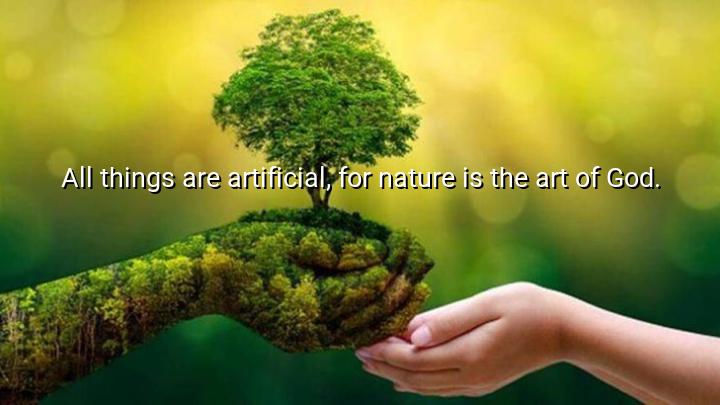




The quote "All things are artificial, for nature is the art of God" by Thomas Browne reflects the idea that everything in the world, including what we perceive as natural, is shaped by a divine or higher creative force. Browne, an English physician and writer from the 17th century, suggests that even the natural world is a form of art, crafted by God. In this sense, what we consider to be nature is not random or chaotic, but a purposeful creation, designed with intricate beauty and structure, much like a work of art.
Browne's perspective challenges the conventional distinction between nature and artifice. While we often think of artificial as something man-made and nature as untouched by human hands, Browne sees both as interconnected. In his view, nature itself is a divine art — a perfect and intentional creation by God. Therefore, everything we create, as humans, is artificial because it is an extension of this higher divine artistry, shaped by human hands rather than directly by nature.
This concept also points to the relationship between creativity and divinity, suggesting that human artistic expression is linked to the divine act of creation. Browne's notion reinforces the belief that human creativity is a reflection of God's power and wisdom. Thus, even when we make something "artificial," it is still part of the larger, divinely ordered creative process.
Ultimately, the quote offers a profound reflection on the interconnectedness of all creation, both divine and human. It invites us to recognize that the boundaries between nature and artifice are not as rigid as they may seem, and that all things, whether naturally occurring or human-made, can be seen as expressions of a higher artistic design.

PAPhuong Anh
What strikes me about this quote is how it redefines the word 'artificial' in a more poetic light. Instead of being ‘fake,’ it becomes a continuation of a larger, divine creative process. But I wonder—does this viewpoint risk blurring the lines too much between stewardship and control? If we see ourselves as artists under God’s influence, does that give us permission to alter the natural world freely, or should we act more reverently?
MLMy Luu
I find this quote comforting. It implies that the world around us—no matter how chaotic or imperfect—is fundamentally rooted in artistic intention. But it also raises a theological issue: if nature is God’s art, are natural disasters or disease part of that artistic vision too? Can something painful still be beautiful or divine? It makes me wonder how people reconcile suffering with belief in a purposeful, artistic creator.
HMTran Ha My
If nature is seen as divine art, then does everything derived from it become inherently meaningful, even if it’s processed or altered by human hands? It raises philosophical questions about the value we assign to natural versus artificial things. Are we too quick to devalue something just because it’s been ‘man-made’? What if we looked at human innovation as part of nature’s evolving expression?
QMtran quang minh
There’s something deeply humbling about this quote. It suggests that even the most basic tree or river is the result of a higher artistic vision. Does that mean humans, as part of nature, are artists too—just imitating God’s work through our own forms of creation? And if so, does that make art a kind of worship or spiritual act, consciously or not? I’d love to explore that connection more.
TTThanh thao
This quote really makes me rethink the word 'artificial.' If nature itself is a form of divine art, then maybe everything we create—our tools, buildings, even technology—is just an extension of that original creativity. Do we sometimes draw too sharp a line between what’s ‘natural’ and what’s ‘man-made’? I’m curious how this perspective could influence environmental or ethical debates about modifying nature or creating synthetic life.