

Charity But how shall we expect charity towards others, when we are uncharitable to ourselves? Charity begins at home, is the voice of the world; yet is every man his greatest enemy, and, as it were, his own executioner.
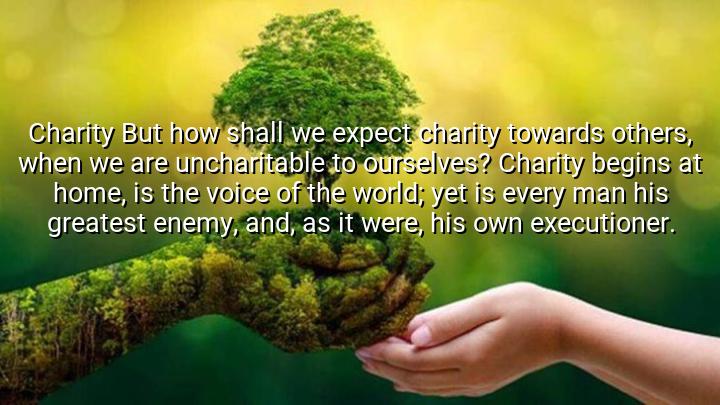




Thomas Browne's quote explores the idea that self-compassion is a prerequisite for showing charity to others. The question, "How shall we expect charity towards others, when we are uncharitable to ourselves?" challenges the notion of offering kindness and generosity to the world while failing to practice it toward oneself. Browne suggests that to truly extend compassion to others, we must first learn to be forgiving and generous to ourselves, as self-neglect or self-criticism undermines the ability to offer kindness to others.
The phrase "charity begins at home" is well-known, reflecting the idea that care and concern for others should start within the family or personal environment. Browne takes this sentiment further, pointing out that if individuals are their own worst enemies—constantly undermining their own well-being—they cannot effectively offer that same charity to others. This suggests that personal well-being and self-love are foundational to broader acts of kindness.
Browne's observation that "every man is his greatest enemy" and his own executioner underscores the destructive power of self-sabotage. By failing to be kind to oneself, a person can unintentionally become their own obstacle, hindering their ability to grow and extend compassion to others. This metaphor implies that harsh self-judgment and resentment lead to a form of inner destruction that makes it difficult to foster positive relationships with others.
Ultimately, Browne's quote invites reflection on the nature of self-compassion as a necessary foundation for effective charity. It speaks to the importance of nurturing a healthy relationship with oneself in order to cultivate a spirit of generosity and care that extends to the broader world.

AAdministratorAdministrator
Welcome, honored guests. Please leave a comment, we will respond soon