

Be able to be alone. Lose not the advantage of solitude, and the society of thyself.
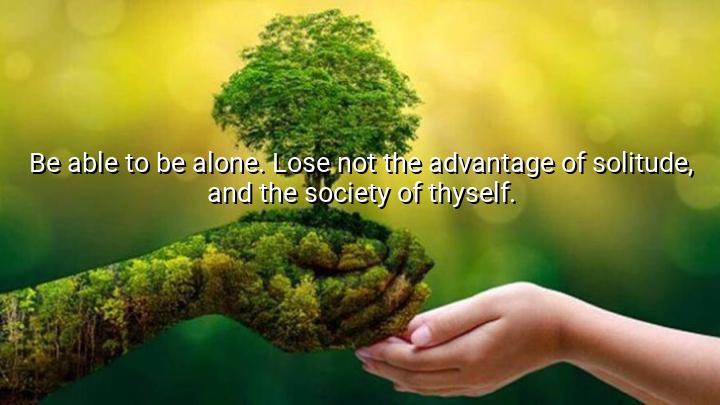




The quote "Be able to be alone. Lose not the advantage of solitude, and the society of thyself" by Thomas Browne emphasizes the profound value of solitude and the importance of being comfortable in one’s own company. Browne urges us to see aloneness not as a burden but as a rare opportunity for self-discovery, reflection, and inner peace. To truly know ourselves, we must first learn to spend time with ourselves—to engage in the society of thyself.
Sir Thomas Browne was a 17th-century English physician, philosopher, and writer, known for his deeply introspective and often spiritual reflections on human nature and existence. This quote comes from his work Religio Medici (The Religion of a Doctor), where he explores the connections between science, faith, and the inner life. Browne believed that the mind could flourish in solitude, provided it was used as a time for wisdom and self-examination.
The phrase “advantage of solitude” suggests that being alone offers a unique kind of freedom—freedom from distraction, societal expectations, and the noise of the world. In this quiet space, one can cultivate clarity, deepen their understanding, and strengthen their character. Browne sees solitude as not just acceptable, but essential for anyone seeking to grow intellectually or spiritually.
Ultimately, Browne's quote is a timeless reminder that we should not fear solitude, but embrace it as a vital part of a thoughtful life. To know ourselves, to find balance, and to build resilience, we must learn to value the moments when we are alone, and recognize that in those moments, we are often in the best company we can keep—our own.

HKDo Hoai Khiem
This quote brings up such a fascinating idea—seeing your own company as valuable. But I have to ask, what happens when someone doesn’t like who they are alone with? The 'society of thyself' might be healing for some, but could be unsettling for others. Does this mean solitude is only enriching if we’ve already done the work of self-acceptance? It’s a profound idea, but maybe not as universal as it seems.
TAThach Anh
Reading this makes me wonder if solitude is a lost art. When was the last time we actually sat with ourselves, without phones, noise, or distraction? I admire Browne’s encouragement to see being alone not as a deficit but a benefit. Still, I’m curious: can everyone access this 'advantage'? Or does it require a certain level of emotional maturity or comfort with self-reflection that not all of us have developed yet?
CVCuoiduytBumbum VigiontanKhocuong
This quote immediately makes me think about the difference between being alone and being lonely. The phrase 'society of thyself' is so beautiful—it suggests that we each contain multitudes worth exploring. But I have to ask, in a world that constantly pushes for productivity and interaction, how do we reclaim solitude without guilt? Is it truly possible to make time for ourselves without feeling like we're withdrawing from life?
TTaobingunha
There's an old-world wisdom in this quote that I find grounding. But I also wonder—can solitude really be an 'advantage' for everyone? For some, being alone is painful or even triggering. So how do we differentiate between healthy solitude and isolating loneliness? Is Browne's idea only applicable when solitude is chosen and not imposed? That nuance feels important, especially when mental health comes into the equation.
Pphuc
This quote feels like a quiet call to self-awareness. It makes me wonder how many people today are actually comfortable in their own company. With so much stimulation and distraction, do we even know how to appreciate solitude anymore? I love the idea of having a 'society of thyself'—but what does that look like in practice? Is it reflection, creativity, or just being at peace without needing anything external?