

You don't take a photograph, you make it.
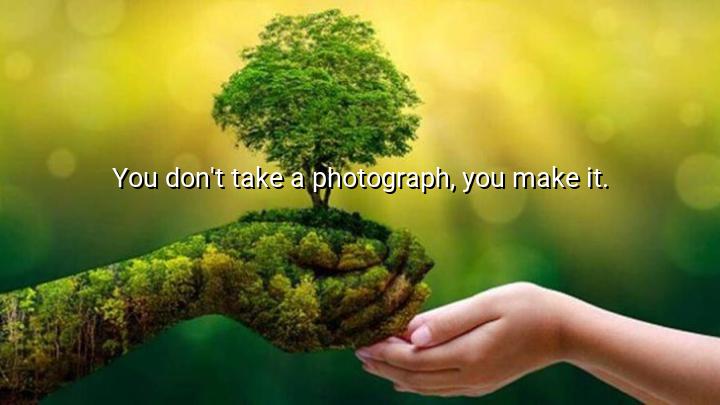




The quote "You don't take a photograph, you make it" by Ansel Adams highlights the idea that photography is not a passive act but an intentional and creative process. Adams, one of the most famous American photographers, is known for his breathtaking black-and-white images of the American West, particularly his work with landscapes. This quote underscores his belief that a successful photograph is not simply a moment captured, but a result of the photographer’s vision, composition, and technical skill.
Adams emphasizes the creative control that a photographer must have over the image-making process. He suggests that photography is not just about pressing a button to capture what’s in front of you but involves making decisions about the framing, lighting, and overall composition to convey a particular message or emotion. In this sense, the photographer is an active participant in shaping the image, almost like an artist crafting their work from the elements around them.
The phrase also reflects Adams' meticulous approach to exposure, development, and printing, which he was famous for. He viewed each stage of the process as an opportunity to make choices that would affect the final result. His use of the Zone System, a technique for achieving optimal exposure, demonstrates how much control a photographer has in creating a photograph, rather than just capturing a fleeting moment.
Ultimately, Adams’ quote suggests that a photograph is much more than a simple representation of reality. It’s an act of creation, where the photographer’s vision and decisions shape the final image, making it a deliberate, artistic expression rather than a passive snapshot of the world.

NNhu
Adams' quote captures something essential about the artistry behind a photo. It suggests a photograph is crafted, not just captured. That makes me question: how much of photography is preparation versus improvisation? Is 'making' a photo more about planning the shot, editing afterward, or both? I’d love to explore whether this quote applies equally to analog and digital photography, or if it’s rooted in a more traditional method.
LDngoc lan dinh
This line really sticks with me because it challenges the assumption that photography is a simple, reactive process. I’d argue it places photographers closer to painters or writers—artists shaping a narrative with light and shadow. But do you think this perspective might exclude casual or documentary photographers? Can a candid moment be just as much 'made' as a planned composition?
MIMay I'm
There’s a certain philosophical depth to this statement that I find beautiful. It reframes photography as an act of creation rather than passive observation. But I wonder, how does this idea apply to genres like street photography or photojournalism where spontaneity is key? Are those images still 'made' in the sense Adams meant, or does this quote favor more controlled, staged forms of photography?
HVNguyen Hoang Van
As someone who’s just getting into photography, this quote gives me a lot to reflect on. It suggests that a great photo isn’t just about timing or having a good camera—it’s about composing something meaningful, something deliberate. Do you think that mindset changes the way a beginner should approach learning? Should the focus be more on artistic vision than technical mastery from the start?
LVNhat Le van
I find this quote both inspiring and challenging. It elevates photography from mere documentation to an art form, requiring creativity and construction. But it also makes me wonder: in an era of smartphone filters and AI-generated images, are we still 'making' photographs in the same way? Has the ease of technology diluted the artistic intent behind the image? Or can spontaneity still coexist with craft?