

Not everybody trusts paintings but people believe photographs.
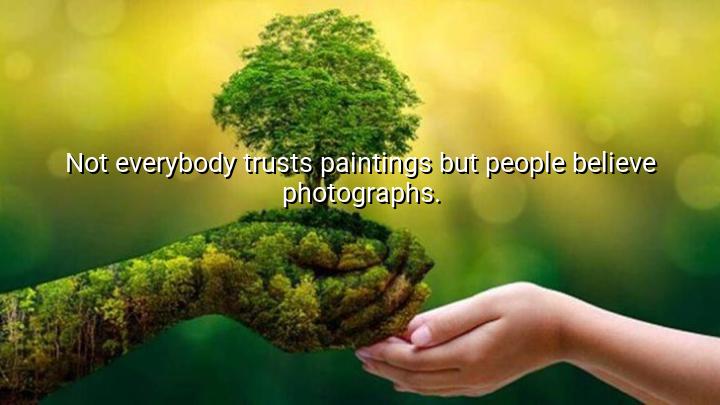




The quote "Not everybody trusts paintings but people believe photographs" by Ansel Adams reflects the contrasting perceptions people have about different forms of art. Adams is pointing out that paintings, due to their subjective nature and the artist's interpretation, can be viewed with skepticism or doubt. On the other hand, photographs are often perceived as more objective and trustworthy, as they capture a moment in time with apparent precision and reality. Adams is emphasizing how photographs are seen as factual representations of the world, while paintings are often considered creative, interpretive, and personal.
In this context, trust and belief refer to the public's tendency to view photographs as more reliable or truthful because they are often associated with realism and direct representation. Paintings, however, involve a certain level of abstraction or manipulation, as the artist interprets and reimagines the scene. This creates a perception that paintings are less "true" and more open to interpretation. Adams contrasts this with photography, which is often viewed as an unaltered snapshot of reality.
The origin of this quote comes from Ansel Adams' deep understanding of the power of photography. As one of the most renowned photographers, especially known for his striking black-and-white images of the American West, Adams recognized the unique role of photography in shaping public perception. His work was celebrated for its technical precision and its ability to capture the natural world in ways that emphasized both its grandeur and fragility.
By stating, "Not everybody trusts paintings but people believe photographs," Adams highlights the way society values different forms of visual representation. While art forms like painting are often seen as expressions of emotion or subjective interpretation, photography holds a sense of authority and truth because it appears to capture reality as it is. This distinction speaks to the cultural importance of photography as a medium that both reflects and influences how we view the world around us.

MQNguyen Phan Minh Quan
I love how this quote subtly critiques how society processes visual information. It assumes that photography is inherently more 'truthful' because of its mechanical nature. But that also assumes the person behind the camera has no bias, which we know isn’t true. So maybe this trust in photography is misplaced. It’s kind of ironic—paintings never promised to be real, yet they might carry more emotional or philosophical truth than photos ever could.
L726. Phung Thi Thao Linh 7A2
Adams raises an interesting point about how medium affects credibility. But today, with deepfakes and digital editing, photography no longer holds the same unquestioned truth it once did. In fact, it might be easier to deceive with a photo now than with a painting. So, if photography loses its credibility, will society rediscover the value in the interpretive honesty of painting? Or will we just become skeptical of all visual art?
PPphong phong
Is this about trust, or about laziness? Photographs give the illusion of being unfiltered truth, so people don’t question them as much. Paintings require effort to interpret, to understand the artist’s choices and message. Maybe that's why people trust photos more—because they don’t ask anything of us. But that also makes me wonder: does that passive trust make us more susceptible to manipulation in visual media?
XKNguyen Xuan Ky
There’s an underlying sadness in this quote, I think. It hints at how society values objectivity over subjectivity, or maybe realism over emotional expression. Paintings are often dismissed as fantasy or personal vision, even though they can reveal deeper truths than a photo ever could. Have we become so obsessed with ‘what actually happened’ that we’ve lost appreciation for what something could mean on a symbolic or emotional level?
VTvy thuy
This quote really gets me thinking about perception and truth. Why is it that people instinctively believe photographs more than paintings? Is it because photos seem to capture a real moment, while paintings are more obviously filtered through an artist’s imagination? But with all the digital manipulation and AI tools now, can we still trust photos like we used to? I wonder if this quote feels more ironic today than when Adams first said it.