

You begin with the possibilities of the material.
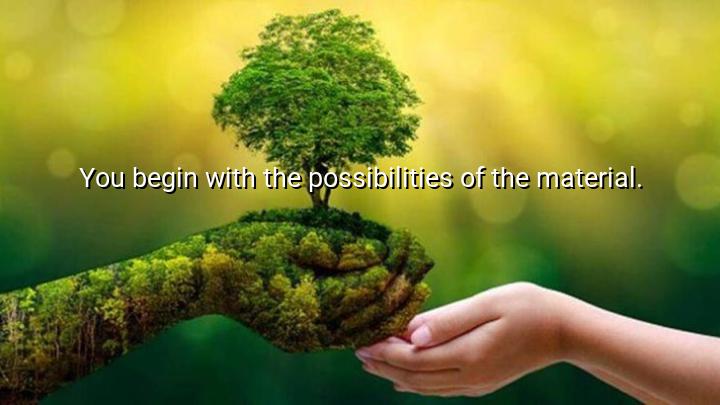




The quote "You begin with the possibilities of the material" by Robert Rauschenberg highlights the idea that the creative process starts with an exploration of the inherent potential within the materials used in art. Rauschenberg, a leading figure in the Combines movement, was known for incorporating unconventional materials—such as scrap metal, newspaper clippings, and even everyday objects—into his works. By saying that you begin with the possibilities of the material, Rauschenberg emphasizes that the first step in the artistic process is to understand and experiment with the unique characteristics and qualities of the materials at hand.
Rauschenberg's approach challenges traditional ideas about the role of materials in art. Rather than seeing materials as mere tools to create a specific vision, he saw them as integral to the development of the work itself. Each material, he believed, has its own possibilities, textures, and meanings, which can shape and guide the final outcome. This perspective reflects his desire to break away from traditional artistic conventions and embrace spontaneity and innovation in the creative process.
This approach also aligns with Rauschenberg's broader philosophy of art as a dynamic and experimental field. He was known for using materials that were typically associated with the mundane, everyday world, and transforming them into something meaningful and artistic. By beginning with the possibilities of the material, he allowed his works to evolve organically, often incorporating aspects of assemblage and collage to create complex, layered compositions that challenged the boundaries between different artistic media.
Ultimately, Rauschenberg’s quote emphasizes the idea that art is not just about imposing an idea onto a blank canvas, but about engaging with the material itself and uncovering its full potential. The artist's role, according to Rauschenberg, is to explore these possibilities and allow the material to inspire and guide the creative process, resulting in works that are as much about discovery as they are about creation.

VTVan Thao
Rauschenberg’s quote makes me think about limitations as creative catalysts. When we begin with what a material can and can’t do, we’re actually setting up the boundaries that make innovation possible. Isn’t that what makes great art? Not endless freedom, but the skill to turn constraints into something expressive. Do others feel this way when working with certain media—like how clay dictates form, or film dictates time?
HV40. Tran Thi Hong Van
This quote feels like a lesson in humility. Instead of imposing a vision, it suggests we listen to what the material is capable of, almost like it has a voice. That makes me think—how do artists choose their medium? Is it based on what they want to say, or what the material might reveal on its own? Maybe it’s both. Either way, it’s a beautiful, patient approach to creation.
BBBang Bang
Does this quote imply that the artist is in a kind of dialogue with the material? I love the idea of art being a collaboration rather than a unilateral act of expression. It also makes me wonder how much we lose when we don't truly engage with the properties of what we’re working with. In a digital age where everything is so virtual, is this kind of tactile respect for material fading?
MQHoang Minh Quan-.-
I find this quote practical and grounded, yet deeply philosophical. It brings up an interesting question: are artists discovering or inventing? If we start with the material, does that mean we’re more like explorers than creators? I’d love to hear what others think about how this mindset changes the way we interpret art—especially pieces made from found or unconventional materials, like Rauschenberg’s own combines.
LTLoi Truong
This quote really resonates with me because it emphasizes the importance of materiality in the creative process. It suggests that inspiration isn't just an abstract idea—it can come directly from the texture, shape, and limitations of the material itself. I wonder if Rauschenberg was also challenging the notion that art has to begin with a concept or narrative. What does this say about improvisation and the role of intuition in making art?