

An empty canvas is full.
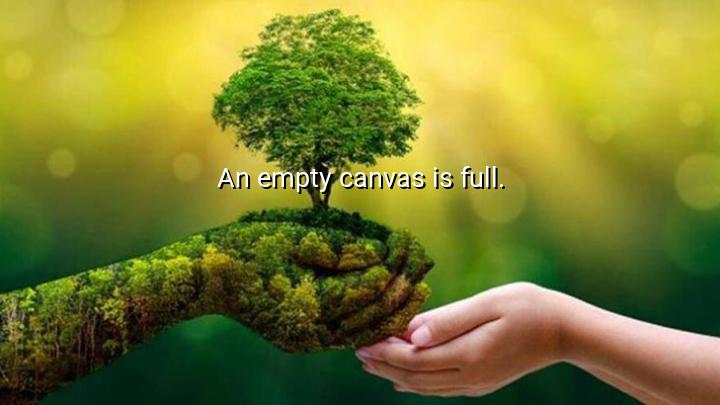




The quote "An empty canvas is full" by Robert Rauschenberg suggests that even an unfinished or unpainted canvas holds possibility and potential. For Rauschenberg, an empty canvas is not merely a blank space waiting to be filled, but a starting point full of ideas, creativity, and opportunity. The emptiness is full of the potential for the artist’s expression, imagination, and the possibilities that are yet to be explored.
Rauschenberg, an influential figure in the Abstract Expressionist and Pop Art movements, was known for his experimental approach to art, often using unconventional materials and techniques. His work challenged traditional notions of art by blurring the lines between different artistic media and forms. This quote reflects his belief that art begins with an open, empty space—one that is full of freedom and creative potential, ready to be shaped by the artist’s hand.
The origin of this quote reflects Rauschenberg’s philosophy of artistic process, where the canvas represents not just a surface but a symbol of unlimited possibilities. By emphasizing that the empty canvas is full, Rauschenberg encourages artists to see beyond the absence of marks or images, focusing instead on the creative energy and potential waiting to emerge. For him, the process of creation was about possibilities rather than restrictions.
For artists, this quote serves as a reminder that an empty space, like a blank canvas, is not something to be feared or avoided but an open field ready to be filled with ideas and expression. It challenges creators to embrace the unknown and to see the potential in every beginning. The empty canvas, in Rauschenberg’s eyes, is as full of potential as the completed work itself, offering endless avenues for artistic discovery.

TTTran thu trang
Reading this quote, I’m struck by how it elevates the concept of potential over execution. It’s like Rauschenberg is saying the canvas is already art, simply by existing within the realm of intention. That really challenges our definition of art. Is it only found in the final product, or also in the silent moment before creation begins? Maybe the canvas holds not just artistic possibilities, but the psychological complexity of the artist.
NBNguyen Ba
As someone who struggles with starting creative projects, this quote really hits me. That blank space always feels intimidating—not because it’s empty, but because it demands something from me. It’s full of all the things I could say or do, but haven’t yet. Sometimes that fullness is inspiring; other times, it’s suffocating. How do seasoned creators deal with that weight of possibility? Is it something that ever gets easier?
CTCuc Tran
Rauschenberg’s statement intrigues me because it seems so contradictory, yet oddly true. It feels like a koan—simple, but layered. Could the canvas be full because it holds infinite interpretations? Or is the 'fullness' more emotional, reflecting the artist’s inner world projected onto it? I’d be really interested in how non-visual artists—like writers or composers—interpret this idea in their own creative practices. Does a blank page feel similarly ‘full’ to them?
DHDiemm Huynh
This makes me think about the tension between potential and realization. A blank canvas can be full of promise, yes—but also full of pressure. It’s almost like Schrödinger's box in art: every idea lives there until you commit to one. So I wonder, does 'fullness' in this context mean creative abundance or creative burden? Could it be both? How do artists learn to navigate that overwhelming sense of everything at once?
VTHoang Van Tuc
I love how this quote challenges the idea of absence. It reminds me of how silence can be just as powerful as sound in music. Could this be an invitation to value what's not yet expressed? Or maybe it suggests that the artist projects so much onto the canvas before anything is even painted. Either way, it's a poetic reminder that beginnings are never truly empty—they’re loaded with expectations, fears, and dreams.