

You answer anger with love. You answer anger with selflessness. The answer to anger is always the opposite thing of anger.
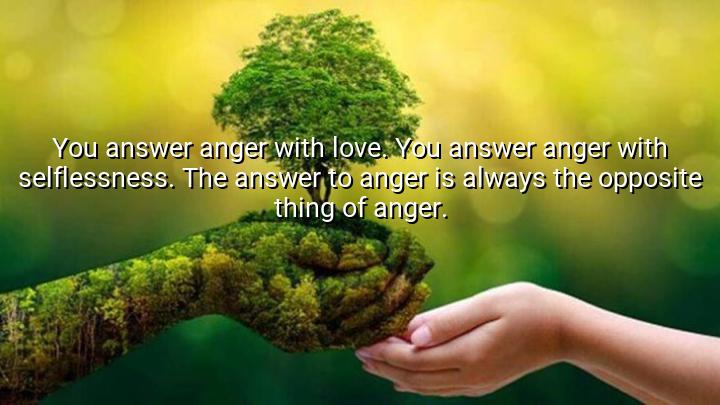




In this quote, Anthony Ramos suggests that the best way to address anger is not with more anger, but with love and selflessness. He emphasizes that responding to anger with its opposite—compassion and understanding—can defuse conflict and create a more positive environment. Ramos implies that anger only perpetuates negativity, and the antidote lies in showing kindness and putting others' needs before your own, thereby breaking the cycle of hostility.
Ramos’ statement speaks to the power of empathy and emotional intelligence in handling difficult situations. Instead of reacting impulsively with anger, which often escalates conflict, he encourages a mindful approach that seeks to de-escalate through calm and selflessness. By responding to anger with love, individuals can foster understanding and encourage healthier, more respectful interactions.
The origin of this quote comes from Ramos’ experience in the entertainment industry, where he has used his platform as an artist and actor to promote positive values and address social issues. His commitment to promoting peace and self-awareness reflects a broader message of reconciliation and personal growth. As an advocate for emotional well-being, Ramos’ words resonate with the idea that overcoming anger requires conscious effort and a shift toward more constructive emotional responses.
Ultimately, Ramos’ quote highlights the transformative power of responding to anger with its opposite. Rather than letting anger dictate behavior, choosing love and selflessness creates an opportunity for growth, healing, and more harmonious interactions. By embodying this approach, individuals can break free from cycles of negativity and foster an environment where conflict is resolved peacefully.

HHHieu Huynh
This quote left me with a mix of inspiration and curiosity. I believe in answering darkness with light, but sometimes anger feels justified—protective even. How do you respond with love without invalidating your own pain? And what happens when your selfless response is taken for granted? I think there’s wisdom here, but it requires a deep emotional maturity that most of us are still learning to cultivate.
LLLiin Lin
I admire the message of love overcoming anger, but I also think it depends on context. In some social justice spaces, anger is a tool for awakening and change. Does this quote suggest that anger is always a negative force? Or could it be that love doesn’t erase anger, but reshapes how we act on it? I'd love to hear more about how Ramos balances emotion with activism.
XTLe Xuan Truong
This quote feels like an emotional version of Newton’s third law—opposite forces creating balance. But I wonder, can suppressing your own anger in favor of selflessness backfire over time? How do you honor your own emotions while still choosing a peaceful response? It seems like the key is not denying your anger, but transforming it into something that leads to connection rather than escalation.
LPlan pham
What stands out to me is the framing of love and selflessness as active responses, not passive retreats. I’ve always been skeptical of ideas that suggest turning the other cheek without offering tools for how to do it. This quote makes me want to ask: how do we practice this in daily life? What does love look like when you're facing anger from someone you care about—or from a complete stranger?
LLLinh Le
I appreciate the aspirational message here, especially in a world that feels increasingly reactionary. But is it realistic to expect people to always counter anger with its opposite? Emotions are complicated, and in the heat of the moment, love isn’t always accessible. Is this something that can be trained, like a muscle? Or is it more of a personal philosophy that some people can embody while others may struggle with?