

Yes, an individual could be electronically stimulated to fear, anger, or euphoria from a distance. However, the procedure is complicated, not always accurate, and far too tedious and expensive as a method for taking over control of the world.
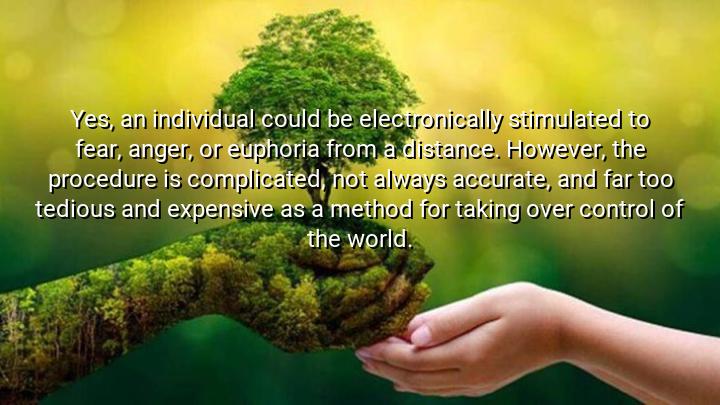




In this quote, Marilyn Ferguson acknowledges the possibility of manipulating human emotions, such as fear, anger, or euphoria, through electronic stimulation from a distance. She highlights the idea that while technology has advanced enough to influence emotional states remotely, the process is far from simple. Ferguson emphasizes that the method is complicated, inaccurate, and costly, suggesting that it is not a practical or efficient means for widespread control.
Ferguson’s words reflect concerns about the potential for technological manipulation in the future, a theme often explored in discussions about surveillance, mind control, and social engineering. She suggests that while such capabilities exist in theory, the practical limitations make them unlikely to be used on a large scale, such as for controlling the world or society at large. This perspective challenges dystopian narratives where technology is used to exert power over individuals.
The origin of this statement likely stems from Ferguson’s interest in the intersection of science, technology, and human behavior. As a writer and thinker, she often delved into topics related to the mind, human consciousness, and societal influences, recognizing the potential dangers of technological advancements but also acknowledging their inherent limitations.
Ultimately, the quote speaks to the complex relationship between technology and human emotions. While the idea of electronically influencing emotions raises ethical and practical concerns, Ferguson’s perspective reminds us that technological control, especially on a global scale, remains an unrealistic and overly ambitious goal due to its limitations and costs.

NBNguyen Bach
I wonder about the psychological impact on individuals knowing that emotions could potentially be manipulated electronically. Even if it’s not widespread or easy, could the fear of such control affect behavior or trust in technology? It’s interesting to consider how perception and reality influence our relationship with emerging scientific possibilities.
TDLe Tien Dung
This perspective makes me question how prepared society is to regulate or monitor technologies that can affect emotions. Are there existing frameworks to prevent abuse, or are we behind in understanding the risks? The mention of expense and complexity suggests a barrier, but should we still be cautious about future developments?
NNNguyen Nhut
Reading this, I think about the broader implications of technology's role in shaping human behavior. Even if remote emotional control is currently limited, how else might technology subtly influence moods or opinions—through media, social networks, or targeted advertising? It highlights the complex interplay between technology and psychology.
LLLinh Le
I’m intrigued by the idea that, despite technological advances, controlling emotions from a distance remains impractical. Does this mean concerns about mass mind control through technology are exaggerated? What are the real capabilities and limits of neuroscience in manipulating emotions without consent? This quote invites skepticism balanced with curiosity about emerging tech.
HNha nguyen
This quote raises fascinating questions about the limits of technology in influencing human emotions. How close are we really to being able to electronically induce emotions like fear or anger remotely? Given the complexity and cost mentioned, is this more science fiction than reality? It also makes me wonder about ethical considerations and potential misuse if such technology becomes more accessible.