

When you hold on to anger and unforgiveness, you can't move forward.
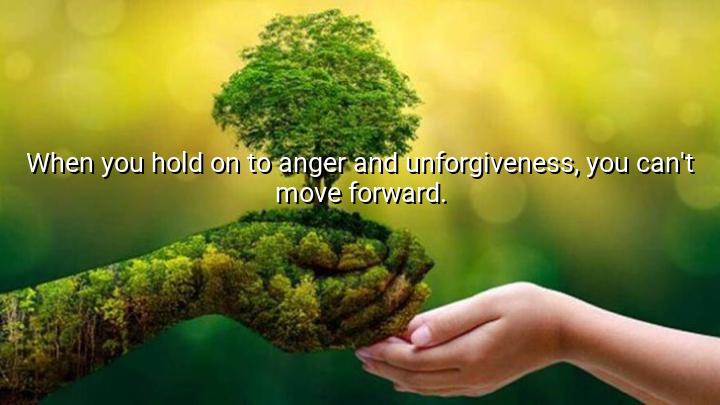




In this quote, Mary J. Blige speaks to the emotional burden that anger and unforgiveness can place on an individual. She suggests that holding on to these negative emotions acts as an obstacle, preventing personal growth and forward movement in life. By holding onto anger and refusing to forgive, one remains stuck in the past, unable to heal or move beyond the pain caused by others. Blige emphasizes that to progress in life, it’s essential to release these toxic feelings and embrace forgiveness.
Blige's message is about emotional liberation and the importance of letting go of past hurts in order to move forward. Unforgiveness can weigh heavily on a person’s emotional well-being, keeping them anchored to their grievances and preventing them from experiencing peace and happiness. Similarly, anger can cloud judgment, create unnecessary stress, and ultimately hinder progress. Blige advocates for healing through forgiveness as a means of emotional freedom, allowing individuals to step into their futures without being burdened by unresolved issues.
The origin of this quote likely stems from Blige’s personal experiences and her journey toward emotional healing. Throughout her career, Blige has been known for her music that often explores themes of struggle, resilience, and emotional growth. Her own experiences with anger and unforgiveness, particularly in relation to difficult relationships, have influenced her perspective on the importance of emotional release and moving forward in life.
Ultimately, Blige’s quote is a call to take control of one’s emotional health and well-being by letting go of anger and unforgiveness. It serves as a reminder that in order to grow, heal, and find peace, individuals must find the strength to forgive, not just others, but also themselves. This emotional freedom is key to living a fulfilled and forward-moving life.

PTPhuong Thu
Mary J. Blige’s quote is powerful, especially coming from someone who's lived through so much. But I’d love to hear more about her personal journey with forgiveness. What made her realize she had to let go? Was it a gradual change or a breakthrough moment? Stories like hers can be so inspiring, especially for people who are still caught in the cycle of bitterness and blame.
HVHuy Vu
This quote makes me think about how emotional wounds can turn into mental blocks. Holding on to resentment really does feel like carrying a weight that keeps you from growing. But I wonder—is it possible to forgive someone without ever getting an apology? That’s the part I struggle with most. It feels incomplete to forgive when the other person doesn’t even acknowledge the hurt they caused.
KKingg
There’s something freeing about this quote, but also something frustrating. Forgiveness is powerful, sure—but it’s not a switch you can flip. What happens if you genuinely want to move forward but the emotion just won't budge? Are there stages of forgiveness, like grief? I feel like people often skip over the 'how' and jump straight to the outcome, which can leave you feeling even more stuck.
THNguyen Thu Hien
I agree with the core message, but what about situations where the anger feels justified—like after betrayal or abuse? Is it even healthy to forgive in those cases, or is it more about finding closure without necessarily absolving the other person? I’d love to explore where the line is between healthy anger and toxic resentment. Not all anger is destructive, is it?
MATa Minh Anh
This resonates with me because I’ve seen how much emotional baggage can stall someone's life. But I’m also curious—does letting go mean you have to reconcile with the person who hurt you? Or is it more about inner peace and acceptance? I think people struggle with forgiveness because they see it as excusing the wrongdoing, which isn’t always fair. What does real forgiveness actually look like?