

When you assume negative intent, you're angry. If you take away that anger and assume positive intent, you will be amazed. Your emotional quotient goes up because you are no longer almost random in your response.
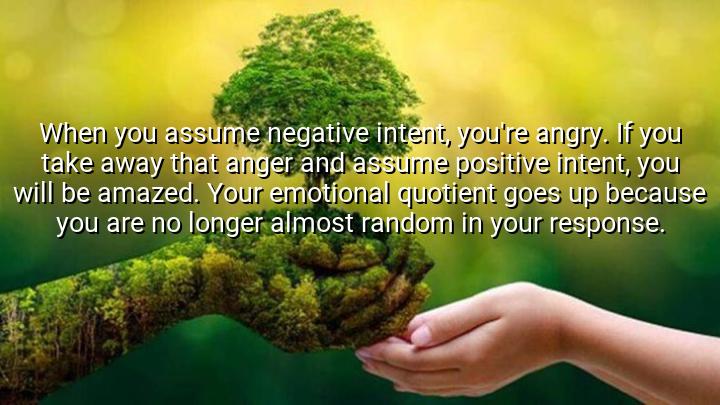




In this quote, Indra Nooyi explores the relationship between anger and the assumptions we make about others' intentions. She suggests that when we assume negative intent, we are likely driven by anger and are quick to react with negativity or defensiveness. However, if we shift our mindset and assume positive intent, our emotional responses change, leading to a more thoughtful and measured approach. By letting go of anger and viewing others' actions more positively, we are able to improve our emotional intelligence, or emotional quotient (EQ).
Nooyi emphasizes that assuming positive intent not only helps us manage our anger but also enhances our ability to respond in a more calm and constructive manner. When we remove the emotional charge of anger, we are no longer acting on impulse or reacting randomly, but instead are able to respond with greater clarity and understanding. This leads to better relationships and more effective communication because we approach situations with a mindset that seeks cooperation rather than conflict.
The origin of this perspective comes from Nooyi’s experience as a successful business leader, particularly during her time as CEO of PepsiCo. Throughout her leadership, Nooyi emphasized the importance of emotional intelligence, leadership, and strategic thinking, often highlighting the value of staying composed and seeking understanding in challenging situations. Her quote reflects her belief that by managing emotions and adopting a positive outlook, one can foster more productive environments and interactions.
Ultimately, Nooyi’s quote serves as a reminder that our emotional reactions, particularly anger, are influenced by our assumptions about others. By shifting our mindset to one of positive intent, we can improve our emotional responses, strengthen our relationships, and enhance our personal growth. It’s a powerful reminder of how perspective and emotional management can make a significant impact on both our professional and personal lives.

LLinhLinh
This quote connects emotional intelligence with the power of perspective. I’m curious if cultural backgrounds influence how readily people assume positive or negative intent. How do social norms shape these assumptions, and what can be done to foster a culture of positive intent in communities? Exploring these questions could provide valuable insights into improving collective emotional health.
HNha ngan
I like the idea that anger can be mitigated by changing our assumptions, but I wonder how deeply ingrained negative assumptions are in our psyche. Does this mean we need to practice mindfulness or other cognitive tools to catch ourselves before anger takes hold? What challenges do people face when trying to consistently assume positive intent, and how do they overcome setbacks?
Kkim
The quote implies that our reactions become less random when we choose to believe in others’ good intentions. But what happens when repeated experiences challenge that belief? How do we maintain a positive outlook without becoming naive? I’d appreciate perspectives on cultivating optimism while staying grounded in reality, especially in environments where mistrust is common.
BMVan Binh Minh
This idea that emotional quotient increases when we assume positive intent resonates with the importance of self-regulation. Could this mindset improve workplace dynamics and personal relationships alike? What role does empathy play in sustaining this positive assumption, and can it be taught effectively? I’m interested in how this shift impacts conflict resolution and communication on a broader scale.
7D7-7a2-Nguyen Dung
I find this perspective quite empowering because it suggests that anger is often a choice tied to our interpretations of others’ actions. But I wonder, are there times when assuming positive intent might make us vulnerable to manipulation or repeated harm? How do we balance generosity of spirit with healthy boundaries? I’d love to hear thoughts on navigating this balance without losing emotional resilience.