

When we can lay down our fear and anger and choose responses other than aggression, we create the conditions for bringing out the best in us humans.
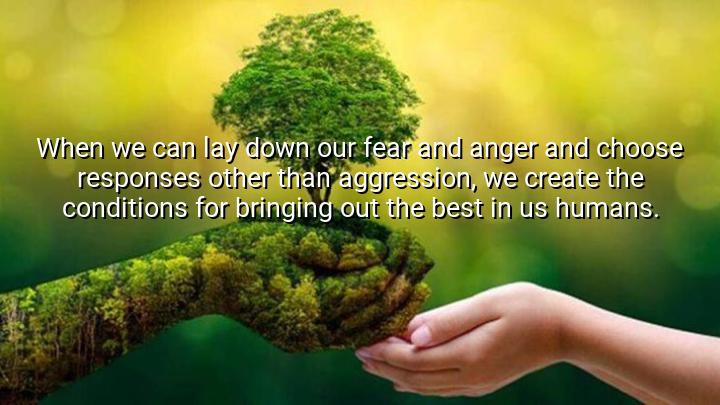




In this quote, Margaret J. Wheatley highlights the transformative power of choosing calmness and understanding over fear and anger. She suggests that when we consciously lay down these negative emotions, especially fear and anger, we open the door to more positive, constructive responses. By choosing responses other than aggression, we create a space for our best qualities—such as empathy, cooperation, and creativity—to emerge. Wheatley emphasizes that by rejecting reactive, aggressive behavior, we can foster an environment where we can better understand each other and thrive together.
The idea behind this quote connects to the belief that fear and anger often drive us toward divisiveness and conflict, while embracing alternative responses—like patience, listening, and compassion—encourages growth and unity. Wheatley advocates for a shift in mindset, one where individuals move away from emotional reactivity and toward mindful responses that can help build stronger relationships and more harmonious communities. This, in turn, leads to a more positive and collaborative way of living.
In terms of origin, Margaret J. Wheatley is known for her work in leadership and organizational change. She often focuses on how people and organizations can work together in more effective, humane ways. This quote reflects her broader philosophy about the importance of leadership in creating environments where people can overcome internal fears and external pressures to unlock their potential. Wheatley's work calls attention to the need for greater self-awareness and emotional intelligence, particularly when navigating difficult or challenging situations.
Overall, Wheatley's message is one of empowerment—encouraging individuals and communities to rise above instinctive emotional reactions and instead cultivate responses that are rooted in understanding and respect. This approach not only enhances personal growth but also strengthens collective well-being, enabling humanity to reach its highest potential.

HHuy
This quote touches something deeply hopeful in me. It implies that we have the potential for kindness, empathy, and reason if we can get past our knee-jerk emotional responses. But I’m curious—how do we create the social or cultural conditions that encourage this kind of human flourishing? Is it about leadership? Community design? Or something more personal, like inner work and mindfulness practices?
TNThuy nhung
Wheatley’s message resonates with me, especially as someone trying to respond more thoughtfully during disagreements. Still, I wonder—can choosing peace ever be misinterpreted as weakness? In competitive or even dangerous environments, is there a risk in disarming yourself emotionally? I think there’s a nuanced discussion to be had about when and how to practice this kind of restraint without compromising personal safety or boundaries.
DQHan Le Diem Quynh
There’s so much wisdom here. It makes me think about how often conflict spirals because we default to defensiveness or hostility. But what are the barriers that stop people from making that shift toward more constructive responses? Is it ego? Trauma? Lack of emotional support? I’d really like to explore what internal and external factors make it difficult to choose peace when aggression feels more natural.
DCTo Dinh chien
I find this quote deeply inspiring, but also somewhat idealistic. In high-stress environments—like politics, parenting, or even corporate settings—how do we cultivate the ability to pause and choose something other than aggression? It seems like a skill that has to be developed consciously. I wonder if this could be taught more widely, maybe in schools or workplaces, to reshape our collective reactions over time.
LDHac Hoang Linh Dan
This quote really made me reflect on how often fear drives our worst behaviors. But how realistic is it to just 'lay down' fear and anger? Isn’t it more about managing or transforming those emotions rather than suppressing them? I’d love to hear more about what practical tools or frameworks Wheatley might suggest to help people reach that level of emotional awareness and intentional response.