

When I judge art, I take my painting and put it next to a God made object like a tree or flower. If it clashes, it is not art.
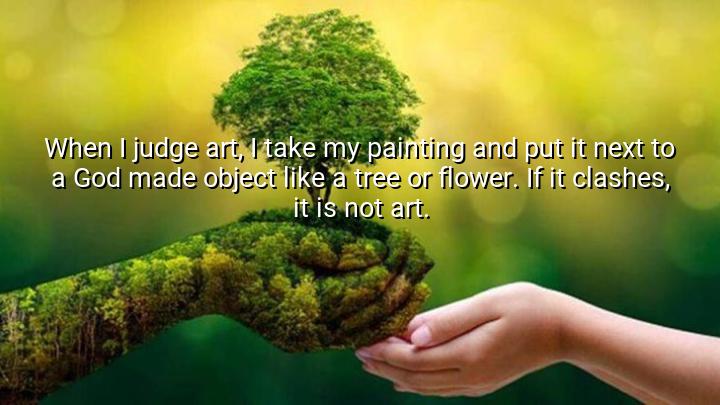




The quote "When I judge art, I take my painting and put it next to a God made object like a tree or flower. If it clashes, it is not art" by Paul Cezanne reflects his belief that true art should align with the natural world in its harmony, simplicity, and balance. Cezanne, a French Post-Impressionist painter, is known for his efforts to bridge the gap between Impressionism and modern abstraction. In this quote, he emphasizes that art should not contradict the natural beauty and order found in nature, but rather, it should complement it.
Cezanne’s approach to art was deeply rooted in observing the world around him with a keen eye for structure and form. By comparing his painting to a tree or flower, both creations of nature, he suggests that art should have an organic quality to it, reflecting the natural harmony found in the world. The notion of "if it clashes" indicates that art should not feel forced or out of place; it must resonate with the same inherent balance that nature offers.
This perspective is central to Cezanne's work, where he sought to represent natural forms with a sense of solidity and structure. He often broke down complex subjects into simple geometric shapes and worked to capture the essence of nature without idealizing or distorting it. For Cezanne, true art was about capturing the underlying structure of the world, and it should align with the natural forms that were inherently beautiful and harmonious.
Ultimately, Cezanne’s quote reminds us that art should be in dialogue with the world around it. It is not enough to simply replicate nature; art must embody the same harmony and balance that exist in natural forms. By placing a painting next to a God-made object like a tree or flower, Cezanne emphasizes that the measure of good art lies in how well it resonates with the natural world, both in its aesthetic and emotional power.

TLTu Luong
Cézanne’s viewpoint is fascinating because it blends aesthetics with a kind of moral or spiritual judgment. But it also feels a bit exclusionary. What about urban, industrial, or dystopian themes in art? They’re not meant to reflect the serenity of nature. Does that make them less legitimate? I wonder how this philosophy would apply in today’s world, where artificial environments dominate and art often serves a critical or political function.
DQNguyen Duy Quang
That quote hit me hard. I mean, if a painting clashes with a flower, it’s not art? That’s a pretty bold stance. But what if clashing is the whole point? Some of the most influential artists create tension, not harmony. So I’m torn—is Cézanne elevating nature as a pure reference point, or is he limiting the definition of art to what’s visually compatible with it? Either way, it’s got me thinking.
PDPhung Dung
I find this quote deeply poetic, but also a bit unsettling. It raises a philosophical question: Is the value of human creativity inherently less than that of natural beauty? Nature is spontaneous, while art is intentional. Could that intentionality give human-made art a different kind of worth, one not meant to be compared to nature but appreciated on its own terms? Or is Cézanne suggesting a spiritual humility in art-making?
KPHuynh Thi Kim Phuong
Does Cézanne's method imply that only representational or naturalistic art qualifies as true art? I’m curious how this applies to digital art, surrealism, or even minimalist pieces. Many modern works don’t strive to resemble nature, and some even purposefully reject it. Would Cézanne see those as clashing, and thus not art? It's a provocative standard, but I wonder if it's still relevant—or even fair—in today’s diverse artistic landscape.
Pphamthanhhuong
This quote makes me feel incredibly humble about what it means to create. If nature is the ultimate standard, how can any artist not feel overwhelmed or inadequate? It kind of makes me question whether art is even meant to compete with nature, or if it serves a different purpose altogether—maybe to provoke, challenge, or simply express something raw. What if the point of art isn’t harmony, but disruption?