

Art is a harmony parallel with nature.
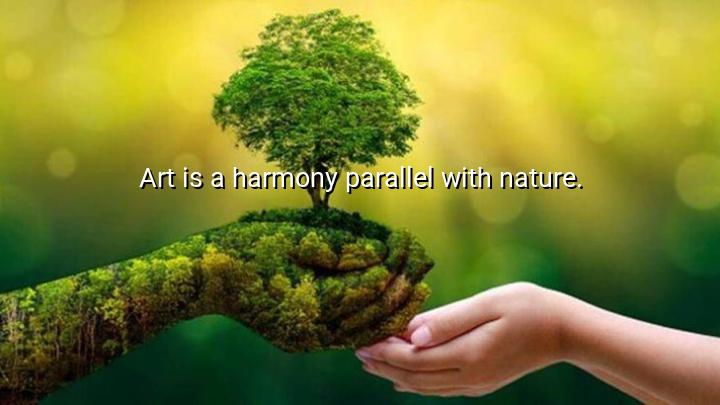




The quote "**Art is a harmony parallel with nature" by Paul Cézanne suggests that art and nature are deeply connected, with art serving as a reflection of the harmonious balance found in the natural world. Cézanne implies that just as nature is composed of elements that work together to create balance and beauty, art should similarly create a sense of harmony through its composition, structure, and use of colors, shapes, and forms. Art mirrors the natural world, but it also interprets and reimagines it, often emphasizing the underlying harmony that might not be immediately obvious in the chaos of life.
In this context, harmony refers to a pleasing arrangement of elements that creates a sense of order, unity, and balance. Cézanne’s approach to art involved simplifying forms and focusing on the relationships between colors and shapes to evoke the essential beauty of nature. His work, especially in landscapes and still lifes, often captured the structure and rhythm of the world around him, reflecting his belief that art and nature share a common foundation of balance and interconnection.
The origin of this quote is tied to Cézanne's role in the transition from 19th-century Impressionism to 20th-century Modernism. As a Post-Impressionist painter, Cézanne sought to understand the fundamental forms and structures within nature. He emphasized the importance of capturing the underlying geometric shapes and harmonious structures in his subjects, which was a departure from the spontaneous, light-focused technique of the Impressionists. For Cézanne, art was not just about what was visible but about uncovering the deeper, harmonious order of nature.
By stating that "art is a harmony parallel with nature," Cézanne underscores the idea that art should be a deliberate and thoughtful arrangement of elements that mirrors the balance and beauty of the natural world. His quote reflects his belief that both art and nature possess an inherent order that artists should strive to uncover and convey in their work. Art, in this sense, is not just a representation of the world but a reflection of the natural harmony that exists within it.

BCNguyen Bao Chau
This quote feels almost spiritual in its simplicity. But it also leaves me with a question: what about art that depicts chaos, destruction, or human suffering? Nature isn’t always harmonious either—it can be violent and unpredictable. So is the harmony Cezanne talks about idealized, or is it meant to encompass the full range of natural experiences, both serene and tumultuous? It’s such a layered concept when you think about it.
HNNg Kim Hong Ngoc
There’s something comforting about this quote—it suggests that art and nature aren’t at odds but mirror each other in spirit. But I do wonder: is that always true across cultures and time periods? Some forms of art deliberately challenge or disrupt natural aesthetics. Does that mean they lack harmony, or is it a different kind of parallelism—like emotional or philosophical harmony rather than visual? I’d love to hear interpretations on that.
CLChi Lan
Cezanne's words resonate with me, especially because they hint at a respectful coexistence between art and the natural world. But I'm wondering—can art ever truly be in harmony with nature if it's made from materials that harm the environment? Should artists think more about sustainability in their practice if they want to stay true to this idea? I feel like this quote invites an ecological responsibility, even if that wasn’t the original intention.
TTDo Thi Tuyet
This quote makes me think about the tension between abstraction and realism in art. If art is a harmony parallel with nature, does that mean abstract or conceptual works are still connected to nature in some underlying way? I’m curious how this applies to digital art or AI-generated images. Can those still be in 'harmony' with nature, or does that harmony require a human touch and organic influence?
HHHoang Hanh
I find this quote really elegant, but I’m left wondering—what does it mean for art to be parallel with nature rather than a reflection or imitation of it? Is Cezanne suggesting that art operates on its own plane, equally valid but separate from the natural world? If so, how do we reconcile that with the fact that so much art draws inspiration directly from nature’s forms, rhythms, and patterns?