

When I have a camera in my hand, I know no fear.
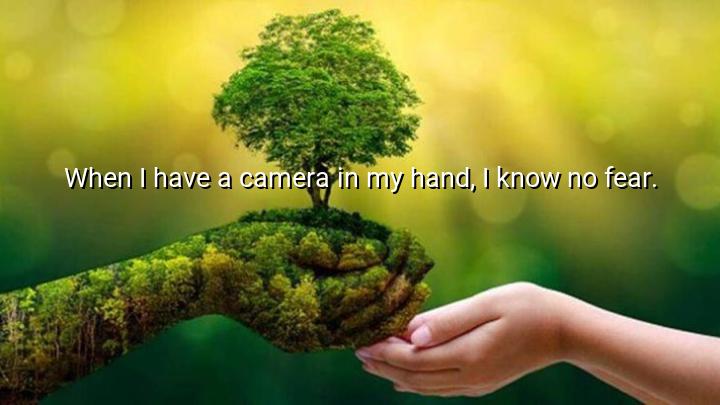




The quote "When I have a camera in my hand, I know no fear" by Alfred Eisenstaedt reflects the sense of confidence and empowerment that photography provided to him. Eisenstaedt, a legendary photojournalist, suggests that the act of holding a camera gave him the ability to face difficult or challenging situations without hesitation or anxiety. The camera becomes a tool not just for capturing images, but for overcoming fear, allowing the photographer to immerse themselves in their surroundings and focus on telling a story, regardless of the risks or pressures they might face.
Eisenstaedt, known for capturing iconic images such as the famous "V-J Day in Times Square" kiss, was deeply invested in the power of photography to convey moments of human significance. His quote speaks to the idea that art—in this case, photography—offers a sense of purpose and clarity, even in the most tense or uncertain situations. For him, the camera was not just a device for taking pictures, but a source of strength, allowing him to navigate the challenges of his profession with fearlessness.
The origin of this quote lies in Eisenstaedt’s long and storied career as a photojournalist, often documenting significant moments of history, from wartime scenes to celebratory events. Eisenstaedt’s ability to remain composed in high-stress environments can be attributed to his deep commitment to his craft and the confidence he felt when using his camera. It was through the lens of his camera that he could connect with the world, capturing raw, emotional moments without being overwhelmed by fear.
For photographers and artists, this quote serves as a reminder of how creativity and passion can act as powerful tools for overcoming personal doubts and fears. Eisenstaedt’s words encourage them to embrace the empowerment that comes from their art, using it as a means of engagement with the world rather than a source of anxiety. It reinforces the idea that, through the lens of a camera or any creative process, one can find confidence and clarity, even in the face of uncertainty.

Aanh
This quote makes me think about the role of purpose in fear management. When we’re driven by a strong sense of purpose, like capturing a meaningful image, does fear simply fade into the background? I’ve noticed that when I’m deeply focused on a goal, fear often loses its grip. So maybe it’s not just the camera—it’s the sense of mission and vision that empowers a person to act boldly.
TLTuyet Le
There’s something poetic about this quote. It’s like saying that art, or the act of making it, has the power to transcend fear. I wonder if this applies beyond photography. Do painters, dancers, or musicians feel this same invincibility when they’re fully immersed in their craft? Maybe what Eisenstaedt is really expressing is that creation anchors us—it gives us clarity and focus when everything else feels uncertain.
TTThu Trang Truong
Does this sense of fearlessness apply to all types of photography—like war, street, fashion, or nature? Or is Eisenstaedt specifically referring to the adrenaline that comes with capturing life in high-stakes moments? I’m curious how this confidence translates across genres. For example, does a wedding photographer feel the same kind of emotional charge, or is it something unique to photojournalism and conflict reporting?
TNTuyen Nguyen
I find this idea incredibly relatable. For me, creating—whether it’s photography, writing, or music—often overrides fear. But I wonder, does the absence of fear lead to better work? Or does it risk making the photographer emotionally detached? Maybe fear isn’t always a bad thing—it can signal sensitivity and awareness. So is fearlessness through the lens empowering, or does it risk dulling our response to difficult realities?
HBHan Bao
This quote makes me wonder about the psychology of photographers. What is it about holding a camera that shifts one’s mindset so dramatically? Is it the sense of mission? The distancing effect of observing life through a lens? I’ve felt more confident with a camera in public too—like I have a reason to be somewhere. Could the camera be a kind of passport into situations we might otherwise avoid?