

We are only beginning to learn what to say in a photograph. The world we live in is a succession of fleeting moments, any one of which might say something significant.
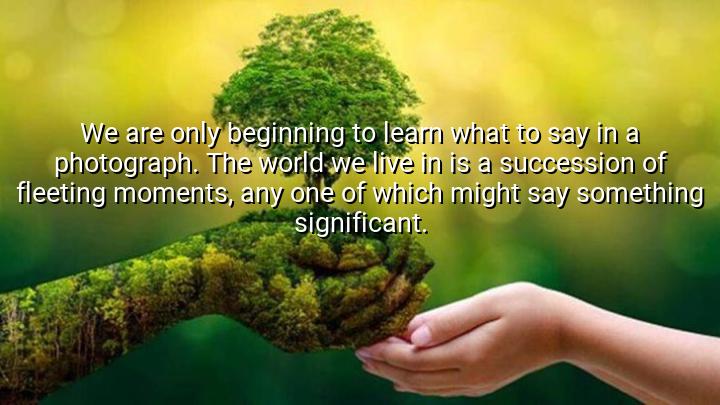




In this quote, Alfred Eisenstaedt reflects on the evolving nature of photography as an art form. He suggests that photographers are still in the early stages of learning how to effectively communicate through images. Eisenstaedt emphasizes that the world is a succession of fleeting moments, where any single moment captured by a camera might convey something significant. This highlights photography’s potential to freeze time and immortalize important scenes, emotions, or events that might otherwise be lost.
The origin of the quote comes from Eisenstaedt’s extensive experience as a photojournalist, known for capturing some of the most iconic images of the 20th century, such as the famous photograph of a sailor kissing a nurse in Times Square on V-J Day. Through his work, Eisenstaedt understood that a photograph could tell powerful stories and evoke deep emotions, yet he also recognized that it takes time to master the art of using a photograph to convey meaning. His statement reveals his belief in the potential for photography to communicate more effectively as artists and photographers continue to evolve their craft.
Eisenstaedt’s mention of fleeting moments underscores the transient nature of life itself. He suggests that significant moments often pass by unnoticed, and it is the photographer’s task to capture those moments and preserve their significance for future generations. The camera becomes a tool for capturing the ephemeral, allowing the photographer to highlight the hidden meaning and beauty in everyday life that might otherwise go unnoticed.
Ultimately, this quote emphasizes the evolving potential of photography as a means of expression. Eisenstaedt’s view challenges photographers to recognize the immense power of capturing brief, yet significant, moments. It invites us to appreciate that a photograph, no matter how fleeting or ordinary it may seem, has the potential to communicate something profound about the world we live in.

THDuong Thi Thu Hien
Eisenstaedt’s quote feels timeless, yet I wonder how it holds up in today’s visual culture. Do influencers, advertisers, and photojournalists all 'say' different things with their images—or are they just shouting over each other? What happens when the intention behind a photo is purely commercial or performative? Can those still be 'significant' moments, or is significance something that demands honesty or depth?
TN17. 7/5 Thuc Nghi
This makes me think about how technology has changed our relationship with photography. With burst mode and AI filters, we’re capturing more fleeting moments than ever. But does that abundance dilute the significance Eisenstaedt talks about? If anything can be photographed instantly, do we still pause to consider what we’re actually saying through the image? Maybe we’re better equipped technically, but still learning emotionally and artistically.
HKPham Le Hai Khanh
I find this quote both inspiring and overwhelming. If any moment could carry meaning, then how do photographers avoid the paralysis of endless possibility? In a world saturated with images, how do we decide what deserves to be captured? And once we’ve taken the photo, how do we know it’s saying what we hoped it would say? There's a kind of beautiful uncertainty in that.
TTNguyen Tuan thanh
This idea really resonates with me as someone who loves candid photography. It suggests there's profound value in the everyday—like you don’t need a perfect setup to capture something important. But how do we train ourselves to recognize these 'significant' fleeting moments? Is it instinct, practice, or something more spiritual? I’d love to hear how photographers develop that eye for what matters in the chaos of real life.
NTNgan Truong
It’s fascinating to think of photography as a kind of language we’re still learning to speak. But who decides what gets said or heard in a photo? Is it the photographer’s intent, the subject’s truth, or the viewer’s interpretation? This quote raises complex questions about authorship and meaning in visual art. Can a moment be significant without context, or does its power always depend on who's looking and why?