

When I first started, my songs were the politics of anger. As I got older and hopefully wiser, I wanted to be part of the politics of answers.
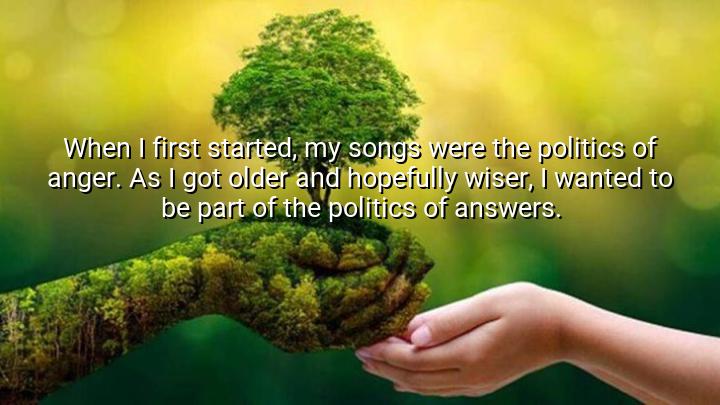




Michael Franti's quote, "When I first started, my songs were the politics of anger. As I got older and hopefully wiser, I wanted to be part of the politics of answers," reflects his personal growth and evolution as an artist. In his early career, Franti used his music as a vehicle to express anger towards societal issues, channeling his frustration into protest and activism. The politics of anger refers to the initial phase of using music to address injustices, often with an emphasis on highlighting problems rather than offering solutions.
As he matured, Franti’s perspective shifted towards a more constructive approach. The transition from the politics of anger to the politics of answers signifies a desire for resolution, not just resistance. This change suggests a broader understanding of the issues he once raged against, and a commitment to finding ways to bring about positive change. The idea of answers represents Franti's aim to offer hope, solutions, and a path forward, rather than merely pointing out the problems.
The origin of this shift in Franti's approach likely comes from his personal experiences and growth as both a musician and an individual. As he gained more insight into the world and his place within it, he recognized the power of positivity and proactive engagement. Instead of dwelling in anger, he sought to foster understanding and change through his music, demonstrating a more holistic, mature way of addressing societal issues.
Franti’s statement emphasizes the idea that with age and experience often comes a greater sense of wisdom. His evolution from focusing on anger to advocating for answers encourages others to move beyond frustration and towards action. The quote suggests that while it is important to acknowledge problems, true progress lies in seeking solutions and fostering dialogue that leads to meaningful change.

QTLe Quang Trung
This quote invites reflection on the purpose of political art. Is expressing anger essential to raising awareness, while focusing on answers drives action? How do artists navigate this progression without alienating parts of their audience? Michael Franti’s journey seems to embody the tension between confronting problems and fostering solutions, which might resonate with many creative activists.
UGUser Google
Reading this, I’m struck by the idea that anger can be a starting point but not an endpoint. What challenges come with shifting from protest to problem-solving in art? Does this approach face criticism for being less radical or too optimistic? It also makes me wonder how this evolution influences the impact of the music on social movements and political change.
UGUser Google
This statement highlights a journey that many artists and activists might relate to. How does moving from anger to answers change the creative process and message? Does it require new skills or collaborations? I’m curious if Michael Franti’s audience has evolved alongside him, and whether they prefer the raw emotion of anger or the hopefulness of answers.
XXebec
I find this transformation inspiring, showing maturity and a desire to contribute positively. But does shifting from anger to answers risk diluting the passion that fuels protest music? Can music both challenge injustices and propose solutions without losing its edge? This quote makes me think about the balance between critique and optimism in political art and activism.
TKBui Trung Kien
This quote reflects a powerful personal and artistic evolution—from expressing anger to seeking solutions. I wonder what experiences prompted Michael Franti to make this shift. Does focusing on answers make music more constructive and hopeful? It raises questions about the role of artists in political discourse—should they primarily voice outrage or inspire change? How might audiences respond differently to these approaches?