

When I am finishing a picture, I hold some God-made object up to it - a rock, a flower, the branch of a tree or my hand - as a final test. If the painting stands up beside a thing man cannot make, the painting is authentic. If there's a clash between the two, it's bad art.
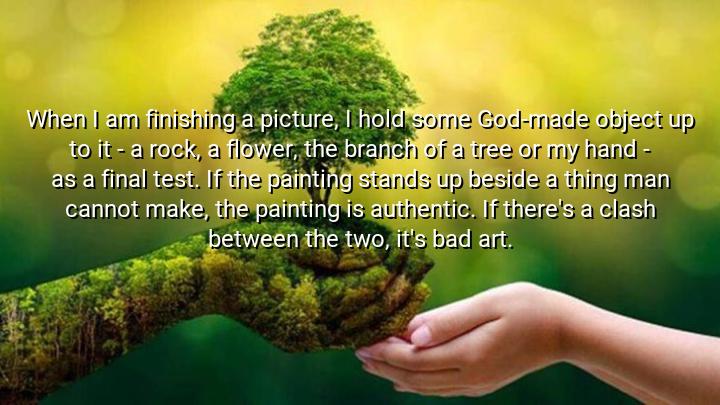




The quote "When I am finishing a picture, I hold some God-made object up to it - a rock, a flower, the branch of a tree or my hand - as a final test. If the painting stands up beside a thing man cannot make, the painting is authentic. If there's a clash between the two, it's bad art" by Marc Chagall reveals his philosophy about authenticity and the connection between art and nature. Chagall suggests that the true measure of art lies in its ability to stand alongside the natural world, which he views as the pinnacle of authenticity. By testing his paintings against objects created by nature—things that humans cannot replicate—he gauges whether the art is genuine and harmonious.
In this context, God-made objects represent the beauty, complexity, and organic qualities of nature that are beyond human control or creation. For Chagall, the painting must not only be technically proficient but also spiritually and visually aligned with the purity and authenticity found in nature. The comparison to natural objects like a flower or a rock is a way for Chagall to ensure that his art captures something profound, something that resonates with the authenticity of the natural world.
The origin of this quote reflects Chagall's broader approach to art, which was deeply rooted in his connection to nature, spirituality, and the inner workings of the human soul. As a painter known for his dreamlike, symbolic style, Chagall sought to convey emotions and universal truths through his work, often drawing from the natural world and his Jewish heritage. His belief in the authenticity of art as an extension of nature speaks to his desire to create works that were not just visually captivating but emotionally and spiritually significant.
By stating that if there is a clash between the painting and a God-made object, the art is bad, Chagall stresses that art must resonate with the natural world’s inherent beauty and truth. This quote highlights his view that authentic art cannot exist in a vacuum; it must reflect the integrity of nature, standing alongside it rather than contradicting it. Through this final test, Chagall’s philosophy encourages artists to seek deeper connections with the world around them, ensuring their art remains pure, meaningful, and true.

HTHien Thu
There’s something deeply romantic about this quote. It feels like Chagall is searching for a connection between his work and the divine. But what happens when the subject of the art is not nature, but something man-made or even imagined? Can a painting of a cityscape or a dream still be held up to a tree branch for validation? I’m curious about how universal this test of ‘authenticity’ can really be.
PHPhu Huynh
Chagall’s method of holding his art next to something from nature feels spiritual, like a final blessing. But isn’t it also incredibly subjective? What if a piece doesn’t 'match' a flower but deeply moves a viewer—does that make it bad art? This quote makes me rethink how we define authenticity. Is it in the artist’s intention, the viewer’s response, or in some mysterious alignment with the natural world?
ANDuc Anh Nguyen
This perspective is both beautiful and intimidating. It suggests that good art must echo the perfection of nature, which feels like an almost impossible task. How many masterpieces would fail this test? And what about art that deliberately opposes or critiques nature—where does that fall on Chagall’s scale? It raises questions about whether 'authenticity' must always align with beauty, or if discord can be just as genuine.
LBLe bo
I respect the reverence Chagall has for nature, but I’m a little torn. If art must pass the test of being compared to something God-made, doesn’t that discredit abstract or conceptual works that don’t strive for natural beauty? There’s authenticity in raw emotion, chaos, and distortion too. Does this quote undervalue those forms, or am I misreading the point? I’d love to hear how abstract artists view this idea.
GDGold D.dragon
Chagall’s standard for judging art is so bold and poetic. It makes me wonder: are artists today still concerned with such a natural benchmark, or has the digital age changed what we compare our creations to? Should the ‘final test’ now include human-made complexity, like algorithms or architecture, rather than just God-made elements? It’s a profound question about authenticity in a world where nature isn’t the only muse anymore.