

In our life there is a single color, as on an artist's palette, which provides the meaning of life and art. It is the color of love.
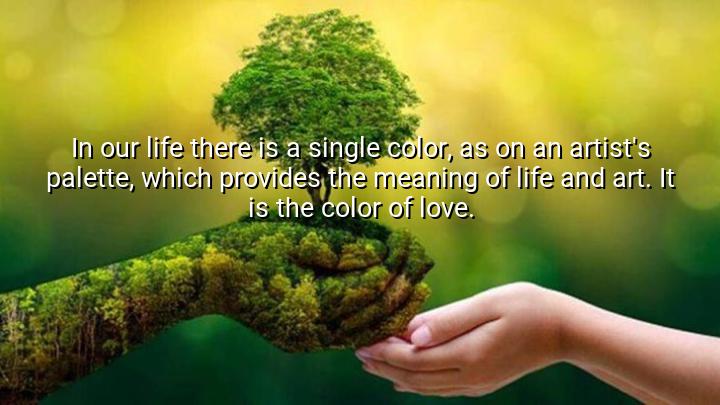




In this quote, Marc Chagall suggests that love is the central force that gives meaning to both life and art. He likens it to a single color on an artist's palette, implying that love is the foundational element that defines and shapes our existence and creative expression. Just as an artist uses color to bring their work to life, Chagall argues that love is the essential ingredient that provides depth, meaning, and beauty to both the world we live in and the art we create.
The origin of the quote reflects Chagall’s lifelong engagement with themes of love, spirituality, and human connection. Known for his vivid, dreamlike paintings that often depicted scenes of romance and faith, Chagall’s work was deeply influenced by his own personal experiences with love and loss. His use of bold colors and symbolic imagery speaks to the emotional resonance he found in love, suggesting that it transcends ordinary human experience and becomes a profound source of meaning in life and art.
Chagall’s view of love as the defining color in life also reflects his belief that art should be driven by emotion and passion, rather than mere representation or technique. In his works, love is often depicted as a transformative force, bringing individuals together and elevating their lives. Through his art, Chagall sought to capture the universal nature of love, illustrating its power to shape our relationships, our understanding of the world, and our ability to express ourselves creatively.
Ultimately, this quote highlights the idea that love is not just an emotion but a vital force that gives meaning to everything we do. For Chagall, it is the core element that both drives and unifies the human experience, whether through personal connections or artistic creation. Love, as the color that defines life and art, provides a deeper layer of meaning and significance to the world around us.

PT38. Nguyen Thi Phuong Tram
This quote reminds me of how deeply personal art can be. If love is the foundation of both life and artistic expression, then is every piece of meaningful art somehow a reflection of love, even indirectly? Whether it's love for a subject, an idea, or a cause? I'm curious—can truly powerful art exist without some form of love behind it, or is love always present, even in disguise?
NMTran Nguyen Nam Minh
I admire the simplicity and optimism in this quote. But in a world that often feels fractured—by conflict, injustice, loneliness—how do we sustain love as that central color? Is it something we cultivate, or is it something that naturally exists and gets covered up? It makes me think about how fragile yet essential love is in both personal and collective healing.
UGUser Google
This quote got me thinking—if love is the color that gives life and art meaning, then what happens when someone feels unloved or struggles to give love? Does their world feel colorless? Can other forces like purpose, curiosity, or even resilience substitute in times when love feels absent? I’d like to believe love is central, but I also think human experience is more layered than a single hue.
DNNguyen Le Duc Nam
Chagall’s metaphor really resonates with me as someone who sees art as an emotional outlet. But I’m also wondering—what does 'the color of love' actually look like to different people? Love itself is so complex: romantic, platonic, unconditional, or even self-love. Could this quote be interpreted differently depending on how someone defines love? And does the ambiguity make it more profound or more vague?
MDDam Minh Duc
This quote feels both poetic and idealistic, but I wonder—is love really the single color that gives meaning to life and art? What about people who create from pain, loss, or anger? Are those emotions just different shades of love, or do they offer their own unique purpose and beauty? I love the sentiment, but it also makes me curious about how other emotions factor into our creativity and existence.