

What's wrong with being angry? There's a lot of stuff to be angry about. If you're angry, anger covers pain. I don't know if you can truly deal with pain.
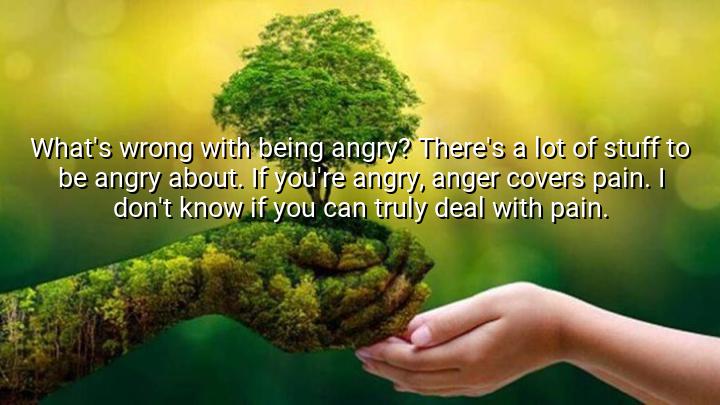




In this quote, Rose McGowan addresses the complex relationship between anger and pain. She challenges the common negative perception of anger, suggesting that anger itself is not inherently harmful, but rather a natural emotional response to the difficult and painful aspects of life. According to McGowan, anger can act as a protective shield, covering or masking deeper feelings of pain that may be too difficult to confront directly. This perspective suggests that anger serves as a coping mechanism, allowing people to momentarily distract themselves from the vulnerability that comes with emotional or physical hurt.
McGowan also questions whether it is truly possible to fully confront and process pain without first experiencing or acknowledging the anger that often accompanies it. Her statement highlights the idea that anger is sometimes a necessary step in the emotional healing process. By feeling anger, individuals may begin to tap into the pain underneath, which can be a crucial step toward understanding and addressing the root causes of their suffering.
The origin of this quote lies in McGowan’s personal experiences and her outspoken advocacy for emotional expression, particularly in the context of the trauma she has faced. Known for her activism, especially related to issues of abuse and personal trauma, McGowan has often spoken candidly about the role of anger in her own healing journey. This quote reflects her belief that anger is a valid and sometimes essential emotion, especially when confronting deep-seated emotional pain.
Ultimately, McGowan’s statement encourages a more nuanced view of anger, acknowledging its role as both a natural and potentially helpful emotion in dealing with pain. By recognizing anger as a signal of underlying hurt, individuals may be better equipped to navigate their emotional experiences and ultimately find a path toward healing and resolution.

4TVy lop 8/3 44_Nguyen Thao
McGowan’s quote makes me reflect on the cyclical nature of pain and anger. If anger covers pain, does unaddressed anger perpetuate the pain by blocking healing? How important is it to create safe spaces where people can express both emotions without judgment? This perspective encourages a more compassionate approach to emotional struggles.
DTThay Du day Toan
This statement challenges the negative stigma often attached to anger. Could embracing anger as a natural response to pain help people feel less ashamed and more willing to seek support? What are the risks of suppressing anger in favor of appearing ‘calm’ or ‘strong’? It’s a powerful reminder of the emotional layers beneath surface behaviors.
NPNgoc Pham
The idea that there’s a lot to be angry about speaks to societal issues as well as personal struggles. Can collective anger be a catalyst for social change while also masking individual pain? How do communities balance validating anger with promoting healing and reconciliation? McGowan’s words highlight the complexity of emotional responses to injustice and suffering.
KMKhanh My
I’m intrigued by McGowan’s uncertainty about dealing with pain without anger. Does this suggest that pain is too overwhelming to face without some form of emotional protection? How do people develop the courage or tools to confront pain directly? This quote invites discussion on the relationship between emotional defense mechanisms and genuine healing.
WEWon Eira
This quote raises interesting questions about the function of anger. If anger covers pain, is it possible that those who express anger are actually reaching out for help in their own way? How might this understanding change how we respond to others’ anger? It also makes me wonder if we can truly address trauma without acknowledging the underlying pain beneath the anger.